
One small change can feel harmless. Then another arrives. Soon, your deadline moves, your profit drops, and the project no longer looks like the work you agreed to deliver.
You can protect your time without sounding cold. This guide shows you how to review the agreement, spot scope creep, explain the impact, and give your client a fair next step.
What the top results do well: CTA lessons from the SERP
The leading pages for this topic share one important quality: they solve an urgent work problem before asking the reader to act. This matters because most visitors arrive with a question, not a buying decision.
Atarim: A tool-led B2B path
Atarim’s article is aimed at agencies, web teams, and professionals who need to control feedback across a project. Its primary goal is to inform while supporting a software conversion. The offer category is an online service.
The likely CTA format is a product link or button. It works best after the article explains how scattered comments, email threads, and unclear approvals slow a project. The tone is useful and practical, not forceful. The target reader is a warm B2B prospect who already feels the pain and may be comparing tools.
Rock: Workflow improvement for teams
Rock’s page focuses on the problem of never-ending changes. Its audience includes freelancers, agencies, and creative teams. The article educates readers about setting limits and improving communication, while its wider business goal is to introduce a collaboration platform.
The CTA is most effective when placed after a process explanation. A reader who has seen the value of one location for feedback is more ready to explore an online service. The desired action is usually a trial, registration, or product visit.
Paige Brunton: Trust first, then a relevant offer
Paige Brunton’s article is closely matched to freelance web designers. It uses a more personal voice and speaks to the fear of losing a client. The goal is primarily to inform, with a possible lead or product offer after the reader gains confidence.
This type of page often performs well because the CTA feels native to the advice. A script, course, template, or email resource is a natural next step. The reader is not pushed into a large purchase before learning how to manage the conversation.
Across the SERP, the strongest pattern is clear: explain the pain, provide a simple process, and use a low-friction CTA that helps the reader apply the advice.
Start with a simple boundary tool
Get practical GrowthBy10x resources for clearer client systems, better project control, and stronger freelance income.
Reasonable revisions or scope creep? Use this quick test
Not every request is a problem. A client may notice a typo, clarify a fact, or ask for a small adjustment that fits the original brief. Good service includes reasonable feedback.
Scope creep begins when the request changes the work, adds new deliverables, or requires a fresh round after approval. The key question is not whether the change is small. The key question is whether it belongs inside the agreed process.

Ask five questions before you answer
- Was this change included in the original brief?
- Does it alter an approved page, design, or direction?
- Will it add new research, writing, design, or development?
- Has the agreed number of rounds already been used?
- Could the request affect the deadline or project cost?
A practical example
Suppose you design a home page and include two rounds revisions. A request to change the button color is likely part of a round. A request to create three new landing pages is not. The second request needs a new estimate, even if the client calls it “just one more tweak.”
Use neutral language. Avoid saying, “That is not my problem.” Instead, explain where the request sits in the current scope and what must happen next.
Review the agreement before you push back
Your contract gives the conversation a fair starting point. It moves the discussion away from personal preference and toward the process that both sides accepted.
Find the important lines
Look for the section that defines deliverables, revision rounds, feedback deadlines, approval, extra work, and payment. Check whether the agreement uses the word “round.” One round should mean one collected set of notes, not a new email every day.
Strong agreement language
- The project includes two rounds of revisions.
- Feedback must arrive in one shared location.
- New pages or features require a written change order.
- Work beyond scope is billed at a stated rate.
Weak agreement language
- Revisions are included until the client is happy.
- Small changes will be handled as needed.
- Feedback can arrive through any channel.
- The final cost will be decided later.
If the agreement is unclear, do not hide behind it. Use the current project to reset expectations. You can say that the new request needs a quick scope review before work continues.
Important: A contract is not only protection for you. It also helps the client understand the order of work, the number of decisions required, and the cost of new ideas.
Explain the impact on time, cost, and quality
A client may not see the work behind a small change. A new image can require research. A new page can affect mobile layouts, links, testing, and search settings. Explain the impact in plain language.

Use the impact formula
Request + work required + effect on deadline or budget + clear choice.
For example: “Adding the pricing page will take about six hours for content layout, mobile adjustments, and testing. It would move delivery from Tuesday to Friday. We can add it for $450, or keep the current launch plan and place it in the next phase.”
Do not over-explain
Long defenses can make you sound unsure. Give enough detail to show the work, then present the decision. The goal is not to prove that the client is wrong. The goal is to make the trade-off visible.
Use numbers when possible. “This adds four hours” is easier to understand than “This will take a while.” A clear estimate also helps the client choose between a fee, a later deadline, or a smaller change.
Set clear revision limits without damaging trust
Revision limits work when they are specific. “A few changes” means different things to different people. State the number of rounds, what each round includes, and how feedback should arrive.
Two rounds may be enough for a focused logo project. A complex website may need separate review points for structure, visual design, content, and testing. The number should match the project, not a random industry rule.

Make the limit feel fair
Tell clients what is included, not only what is forbidden. For example, “Your package includes two rounds of collected feedback on the approved direction. Each round can include multiple notes. New directions or deliverables are estimated separately.”
Ready-to-use scripts for client revision requests
The right words can lower tension. Start with recognition, connect the request to the agreement, and offer options. These scripts are short enough to use in an email or project tool.
Script for the first extra request
“Thanks for sending this note. I can make that adjustment. We have completed the two revision rounds included in the current project, so this would be additional work. I can add it for $___ and deliver it by ___. Would you like me to include it?”
Script when the request changes direction
“I understand the new direction. It is different from the approved concept, so it will need a new estimate rather than a small revision. I can prepare that estimate today and show how it affects the project schedule.”
Script when feedback is scattered
“To keep the project moving, please add the remaining notes in the shared feedback location by ___. I will treat that collection as the next revision round. This helps us avoid missed comments and keeps the review process clear.”
Script when the client wants no extra cost
“I understand you want to stay within the current budget. We can either keep the existing deliverable and launch on the planned date, or add this request and move the deadline to ___. Which option works better for you?”
Notice the tone. None of these scripts blame the client. They make the next decision easy. That is how you keep client happy while still protecting your boundaries.
Save these scripts for your next project
Use the GrowthBy10x resource hub for practical systems that help you manage feedback, scope, and freelance growth.
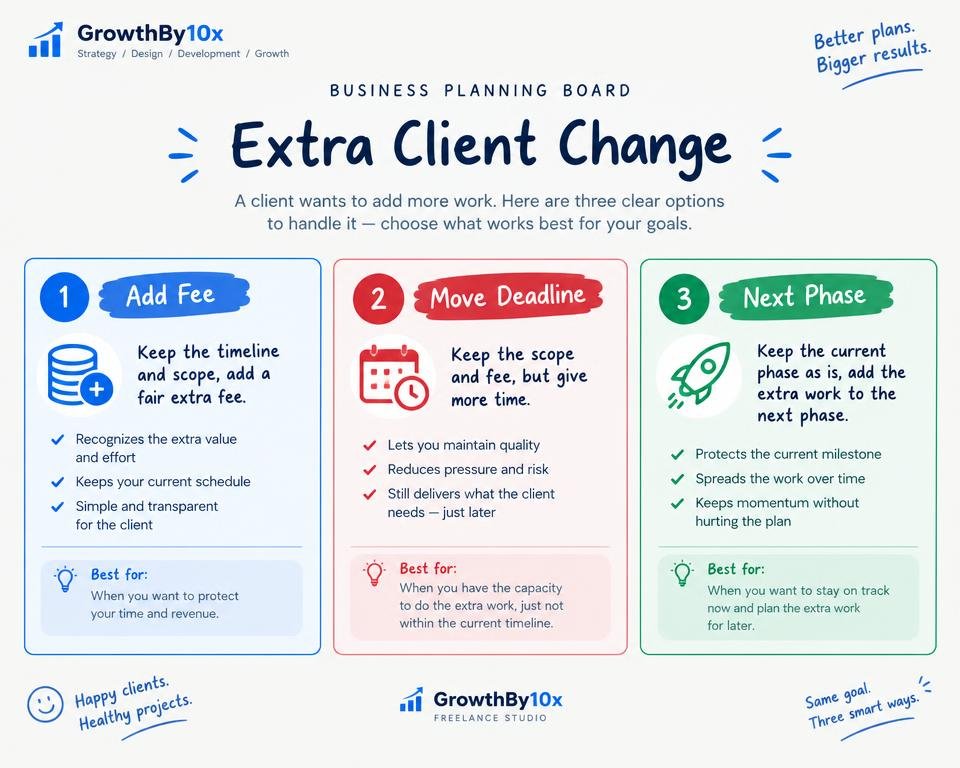
Give the client three fair options
A pushback message feels better when it includes a path forward. Present choices that protect the project without turning the conversation into an argument.
Option one: Add a fee
Keep the current deadline and add the work to the invoice. This is best when the request is urgent or the client values speed.
Option two: Move the deadline
Keep the budget stable but schedule the new work after the original deliverables. This works when time is less important than cost.
Option three: Use the next phase
Record the request and include it in a later phase. This is useful when the change needs more planning or belongs to a future website update.
Give a recommendation when you can. “I suggest placing this in the next phase because the page depends on the final pricing” sounds more helpful than simply listing a fee.
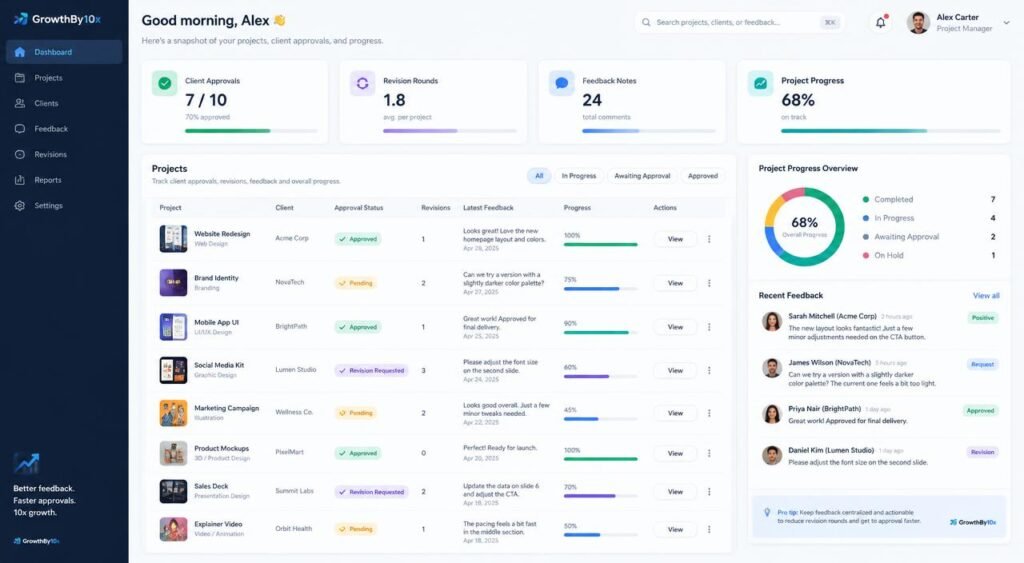
Document approvals and track project progress
Memory is weak during a busy project. Written approval gives both sides a shared record. It also helps you see when a project has moved from planning to production, review, and completion.
Use one location for feedback
Choose one project tool, document, or email thread. Ask the client to keep all revision notes there. If a message arrives by text, copy the request into the main record and confirm it.
Record the decision
After each review, write a short summary. Include the date, the items approved, the remaining questions, and the next phase. Ask for a simple written confirmation before moving on.
| Project point | Record to keep | Next action |
| Brief approved | Deliverables, audience, goals, and limits | Begin the agreed work |
| Design review | One grouped set of feedback | Complete the current round |
| Approval | Written sign-off and date | Start the next phase |
| New request | Impact, cost, and deadline | Approve a change order |
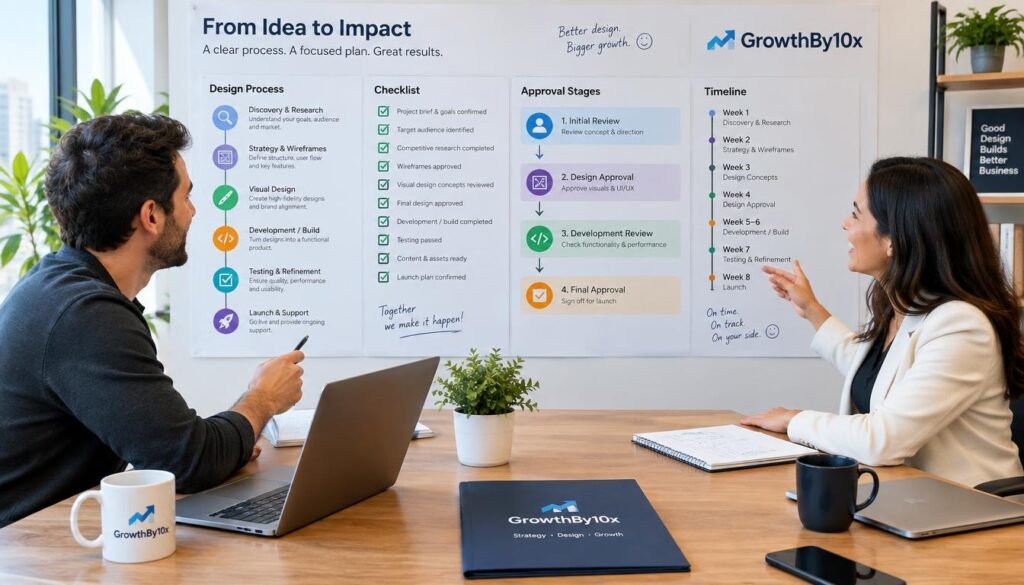
Prevent “just one more tweak” before it starts
The best revision process begins before the first design or draft. Prevention is easier when the client knows how decisions will be made.
Improve the brief
Ask about the audience, purpose, examples they like, examples they dislike, required content, decision makers, and launch date. Good questions reduce late changes because they reveal uncertainty early.
Show work in stages
Do not wait until the final page to request feedback. Review the direction first. Then review the structure. Then review the polished design. Early approval makes later changes easier to control.
Define who can approve
Many delays come from extra stakeholders. Ask the client to choose one person who collects feedback and gives final approval. This reduces duplicate notes and conflicting opinions.
Before the project
- Confirm goals and deliverables.
- Set rounds revisions and review dates.
- Choose the feedback location.
- List the extra-work rate.
During the project
- Confirm decisions in writing.
- Track progress after each round.
- Flag new requests early.
- Pause work when approval is missing.
Keep the client relationship positive while holding boundaries
Boundaries are not a sign that you care less. They show that you take the work seriously. A clear process protects the client from surprise costs and protects you from unpaid effort.
Stay curious when a client sends repeated changes. They may be unsure about the goal, worried about internal approval, or reacting to new information. Ask one useful question: “What problem should this change solve?” The answer may reveal a better solution.
Use warm language. Thank the client for the detail. Repeat the shared goal. Then explain the limit. Avoid sarcasm, blame, or language that labels the client as difficult.

A simple relationship formula
Respect the request + explain the effect + offer a choice + confirm the decision.
This formula works because the client feels heard. You are not refusing to help. You are showing what help requires.
When to stop the project
Some clients ignore every agreement, reject every option, or expect unpaid work as a normal part of the relationship. If the pattern continues after a clear conversation, review your termination terms. Losing an unhealthy project can create space for better work.
Your 24-hour action plan for client revision requests
You do not need to rebuild your whole business today. Start with one current project and make the next decision clear.
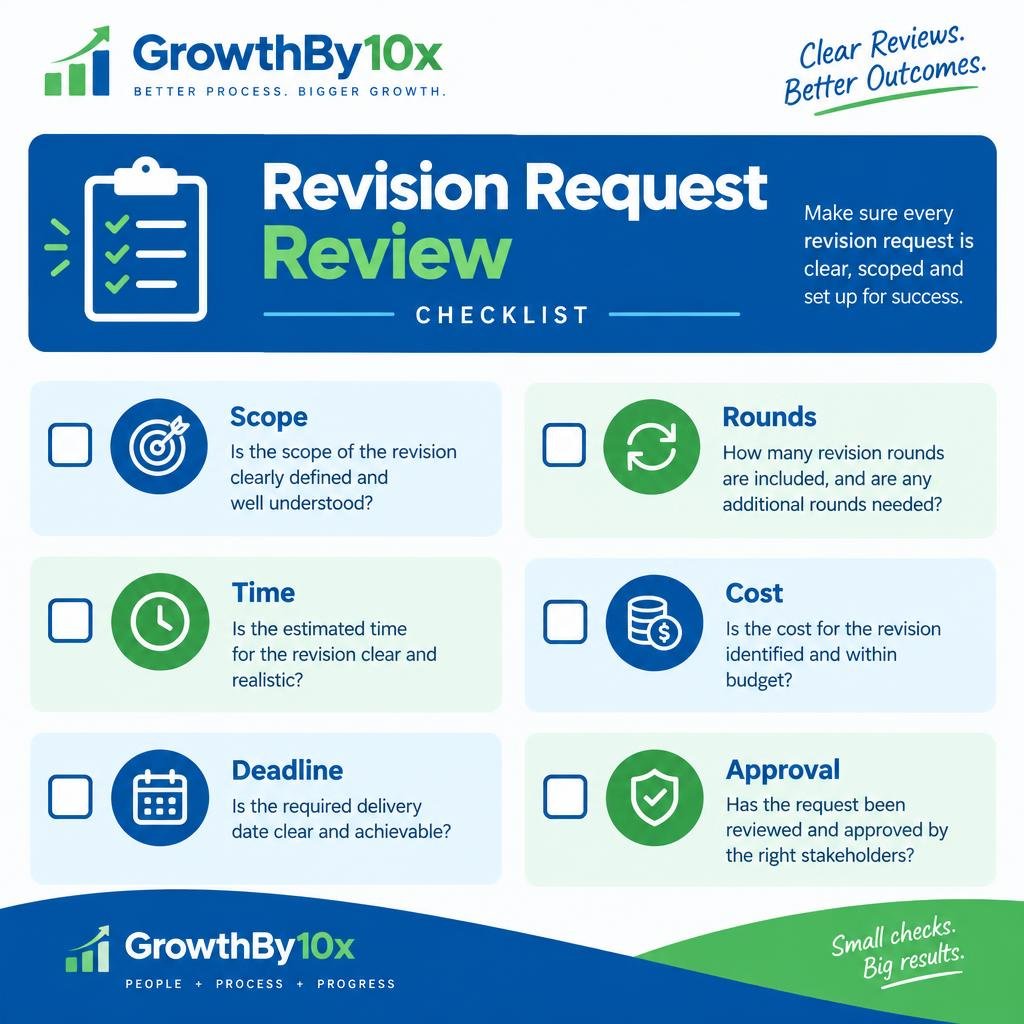
Use a repeatable checklist
A checklist turns an emotional moment into a simple process. It helps you respond with facts instead of frustration and gives the client a fair way to choose the next step.
Push back clearly and keep the work moving
Handling client revision requests becomes easier when you stop treating every new note as a personal conflict. Review the agreement. Decide whether the request fits the scope. Explain the effect on time, cost, and quality. Then offer a fair choice.
Clear limits do not make you difficult. They help clients understand the project, protect your focus, and support better work. When you document approvals and improve your process, “just one more tweak” becomes a manageable business decision.

Build a stronger freelance process
Explore GrowthBy10x for practical guidance that helps you improve your systems, protect your time, and grow income with confidence.
The best response to one more tweak is not a sharp “no.” It is a clear explanation, a fair option, and a process that both sides can trust.