
The artificial intelligence revolution isn’t coming. It’s already here, and it’s creating unprecedented opportunities for you to make money. In 2026, the AI services market has exploded into a multi-billion dollar industry where everyday people are building sustainable income streams by selling AI-powered solutions to businesses and individuals.
You don’t need a computer science degree or years of technical training. The tools available today make it accessible for anyone willing to learn and take action. From content creation to data analysis, businesses everywhere are desperate for AI services that can boost their efficiency and cut costs.
This comprehensive guide shows you exactly how to tap into this massive opportunity. You’ll discover the most profitable AI services to sell, where to find clients willing to pay premium prices, and proven strategies to build a thriving business that generates real income in 2026 and beyond.
The AI Services Marketplace in 2026: Understanding the Landscape
The AI services industry has transformed dramatically. What started as experimental technology reserved for tech giants has become mainstream business infrastructure. Small business owners and enterprises alike now rely on AI tools to stay competitive.
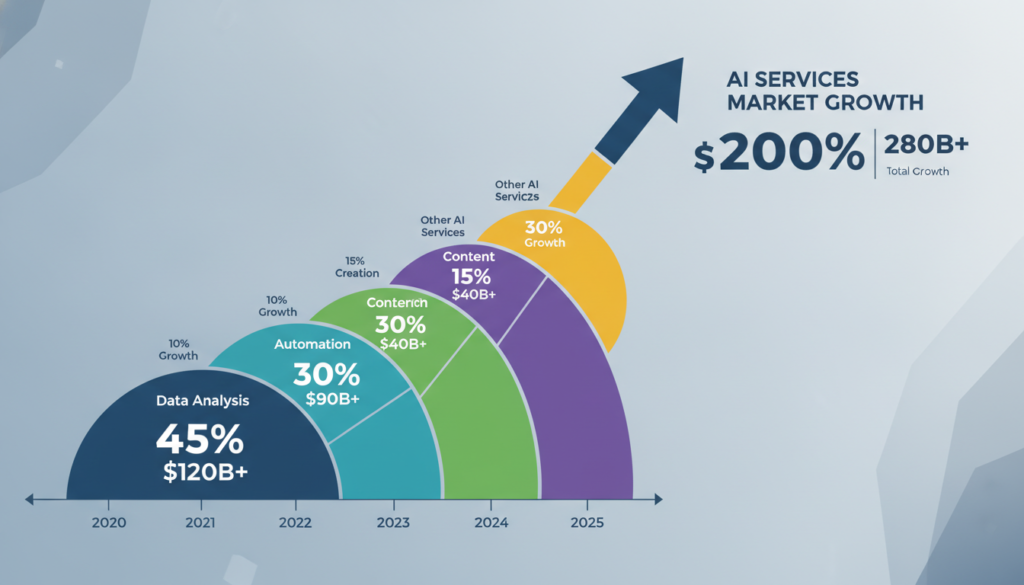
Market research shows the AI services sector reached $184 billion in 2026. This growth creates massive opportunities for service providers who understand how to bridge the gap between powerful AI tools and businesses that need results but lack technical expertise.
The most significant shift is democratization. AI platforms have become user-friendly enough that you can deliver professional services without coding knowledge. This levels the playing field and allows you to compete based on results and customer service rather than technical credentials.
Businesses face a common challenge. They know AI can help them but don’t know where to start. They’re overwhelmed by options and afraid of making expensive mistakes. This creates your opportunity to make money by becoming their trusted guide and implementation partner.
Why Businesses Are Actively Seeking AI Service Providers
Companies of all sizes recognize they must adopt AI to remain competitive. Their competitors are using artificial intelligence to work faster, reduce costs, and deliver better customer experiences. Falling behind isn’t an option.
However, hiring full-time AI specialists is expensive and often unnecessary. Most small business owners need specific solutions implemented, not permanent technical staff. This makes outsourcing to service providers the perfect solution for them and a profitable opportunity for you.
Time pressure intensifies demand. Business owners want results quickly. They don’t have months to research tools and learn systems. They need someone who can step in, understand their needs, and deliver working solutions fast. Your ability to do this becomes extremely valuable.
The Most In-Demand AI Service Categories
Content creation services dominate the market. Businesses need constant streams of blog posts, social media content, email campaigns, and marketing copy. AI writing tools make it possible to deliver high-quality content at scale, and clients will pay well for this capability.
Automation services solve pain points that cost businesses thousands in wasted time. From automating customer service responses to streamlining data entry, companies eagerly invest in solutions that free up their team’s time for higher-value work.
Data analysis and insights represent another lucrative category. Businesses collect massive amounts of information but struggle to extract actionable insights. AI tools can analyze patterns, predict trends, and generate reports that inform better decisions. Clients value this intelligence highly.
Service-Based Income
You deliver AI services directly to clients on a project or retainer basis. This provides steady income and allows you to charge premium rates for specialized expertise.
- Immediate income potential
- Direct client relationships
- Higher hourly rates
- Scalable through team building
Product-Based Income
You create AI-generated digital products or tools that generate passive income through repeated sales without additional work for each transaction.
- Scalable income potential
- Work once, sell repeatedly
- Lower time commitment
- Builds long-term assets
Most Profitable AI Services People Will Pay For in 2026
Not all AI services command equal prices. Understanding which solutions businesses value most helps you focus your efforts on the highest-paying opportunities. The following services consistently generate strong revenue for providers who deliver quality results.
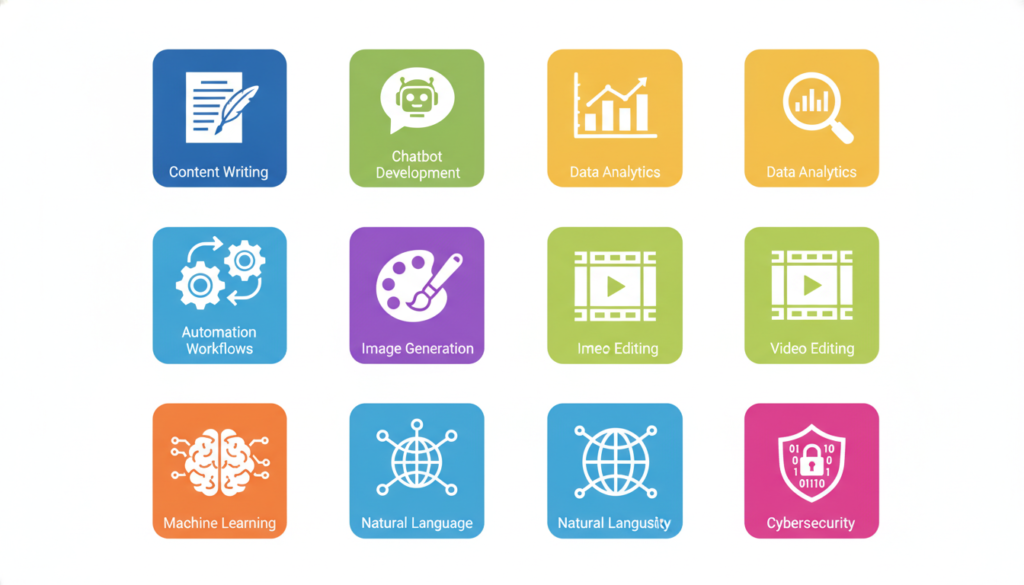
AI Content Creation Services
Content creation remains one of the easiest ways to make money with AI services. Every business needs content, and AI writing tools enable you to produce high-quality output much faster than traditional writing methods.
Blog posts represent steady demand. Small business owners understand content marketing drives traffic and leads, but they lack time to write regularly. You can use tools like ChatGPT, Jasper, or Claude to help research, outline, and draft articles that you then refine and optimize.
Social media content offers recurring revenue opportunities. Businesses need daily posts across multiple platforms. You can create monthly packages where you deliver 30-60 social media posts, captions, and hashtag strategies. This creates predictable passive income through retainer agreements.
Email marketing campaigns provide another profitable niche. Companies know email delivers high ROI but struggle to write compelling sequences. You can offer services creating welcome sequences, promotional campaigns, and newsletter content that converts subscribers into customers.
Blog Writing Services
Businesses pay $150-500 per blog post for well-researched, SEO-optimized content. You can deliver 10-15 posts monthly using AI writing tools.
- SEO-optimized articles
- Industry research and insights
- Keyword integration
- Editing and refinement
Earning Potential: $2,000-6,000/month
Social Media Management
Create and schedule content across platforms. Monthly retainers range from $500-2,000 depending on posting frequency and platform count.
- Post creation and scheduling
- Caption writing
- Hashtag research
- Content calendar planning
Earning Potential: $1,500-5,000/month
Email Copywriting
Email sequences that convert command premium prices. Businesses pay $300-1,500 for complete email campaigns and automation sequences.
- Welcome sequences
- Sales funnel emails
- Newsletter templates
- Subject line optimization
Earning Potential: $1,200-4,500/month
AI Chatbot Development and Management
Customer service automation through chatbots has become essential for modern businesses. Companies want 24/7 availability without hiring night shift staff. This creates opportunities for you to build and manage AI chatbot solutions.
Website chatbots handle common customer questions, qualify leads, and route complex issues to human agents. You don’t need coding skills to create these using platforms like Chatfuel, ManyChat, or CustomGPT. Businesses pay $500-2,500 for initial setup plus monthly management fees.
Lead qualification bots work on websites and social media to engage visitors, ask qualifying questions, and schedule appointments. Real estate agents, consultants, and service providers particularly value this automation. You can charge setup fees plus percentage-based commissions on generated leads.
The ongoing management creates recurring revenue. Chatbots need regular updates, performance monitoring, and conversation flow improvements. Monthly retainers of $200-800 provide steady income while requiring minimal time investment once systems are established.
AI Data Analysis and Business Intelligence
Business owners collect enormous amounts of data but struggle to extract meaningful insights. Your ability to use AI tools for data analysis and reporting solves this challenge and commands premium pricing.
Customer behavior analysis helps businesses understand buying patterns, preferences, and trends. You can use tools like Tableau with AI features or specialized platforms to analyze sales data, website analytics, and customer feedback. Insights that drive better decisions are worth thousands to business owners.
Market research and competitive analysis provide strategic value. AI tools can scrape competitor websites, analyze industry trends, and identify market opportunities faster than manual research. Companies pay $1,000-5,000 for comprehensive market intelligence reports.
Predictive analytics takes this further by forecasting future trends. Retailers want inventory predictions, marketers need campaign performance forecasts, and executives require revenue projections. Your ability to deliver accurate predictions using AI tools positions you as a strategic partner rather than just a service provider.

AI Image and Video Generation Services
Visual content creation has exploded with tools like Midjourney, DALL-E, and Runway. Businesses need custom images and videos but can’t afford professional photographers and videographers for every project. This gap creates your opportunity to make money.
AI-generated art for marketing materials serves diverse needs. You can create social media graphics, blog post images, advertisement visuals, and website illustrations. Packages of 20-50 custom images sell for $200-800, providing excellent profit margins since tools make creation quick.
Product visualization helps e-commerce businesses and startups. Companies can showcase products in different settings, colors, and contexts without expensive photo shoots. Interior designers, furniture retailers, and fashion brands particularly value this service.
Video editing with AI tools streamlines production for content creators and businesses. You can offer services removing backgrounds, adding captions, creating short clips from long videos, and generating promotional videos. YouTube creators, course creators, and businesses building video content libraries need these services regularly.
AI Automation and Workflow Optimization
Repetitive tasks drain productivity across businesses. Your ability to identify automation opportunities and implement AI solutions saves clients thousands of hours annually. This value justifies premium pricing for automation services.
Document processing automation eliminates manual data entry. Businesses dealing with invoices, contracts, or forms can benefit from AI tools that extract information and populate databases automatically. Setup projects range from $1,500-10,000 depending on complexity.
Customer service automation extends beyond chatbots to include email response systems, ticket routing, and FAQ management. Small business owners particularly appreciate solutions that handle routine inquiries automatically, freeing their time for growth activities.
Marketing automation workflows connect multiple platforms and tools. You can set up systems where new leads automatically receive welcome emails, get added to CRM systems, and trigger follow-up sequences. These comprehensive solutions command $2,000-8,000 setup fees plus ongoing management retainers.
Pro Tip: Start with one service category and master it before expanding. Deep expertise in a specific area allows you to charge higher rates and deliver better results than trying to offer everything at once. Focus creates competitive advantage.
Best Platforms and Marketplaces to Sell AI Services
Choosing the right platforms to sell your AI services dramatically impacts your success. Different marketplaces attract different clients, charge varying fees, and offer distinct advantages. Understanding where to position your offerings helps you make money faster.
Freelance Platforms for AI Services
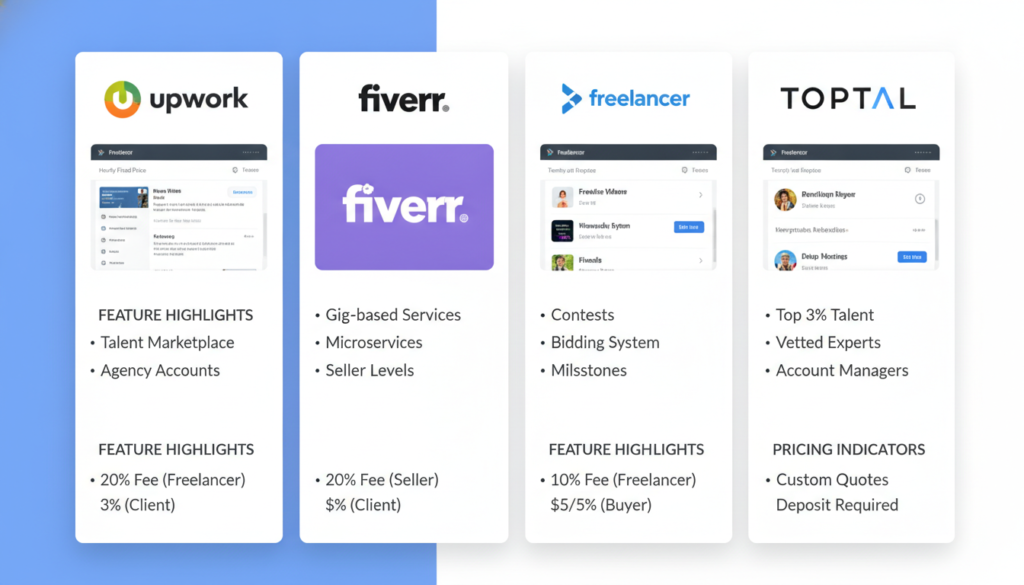
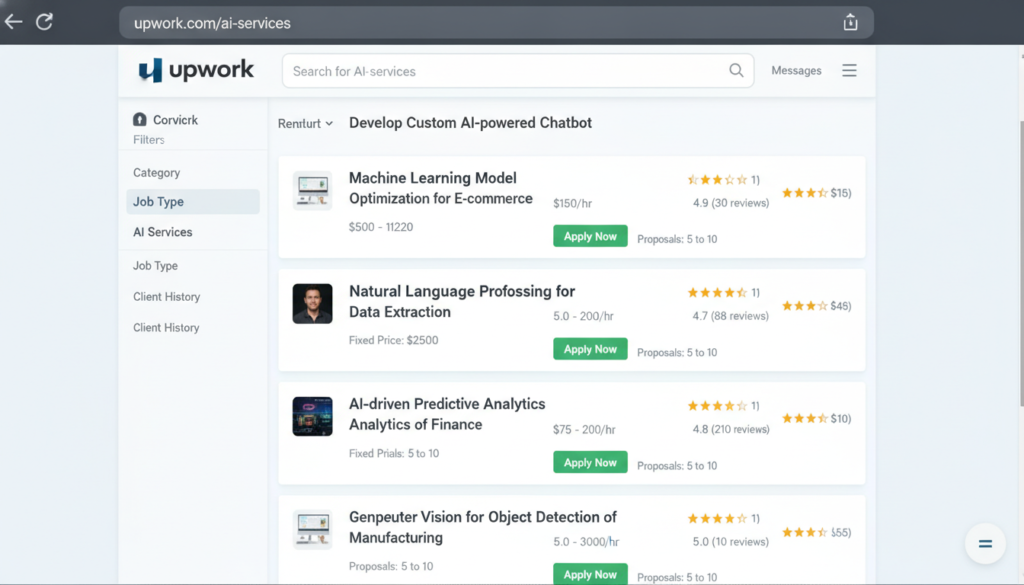
Upwork remains the largest marketplace for professional services. The platform attracts serious business clients willing to pay for quality. You can create a profile highlighting your AI service expertise, submit proposals to posted jobs, and build long-term client relationships.
Competition on Upwork is intense, but specialization helps you stand out. Instead of offering “AI services,” position yourself as an expert in specific solutions like “AI chatbot implementation for e-commerce” or “AI content creation for SaaS companies.” This targeted approach attracts higher-paying clients.
Fiverr works differently with its gig-based model. You create service packages at set prices, and clients purchase directly without negotiation. This platform suits standardized services like “10 AI-generated blog post images” or “ChatGPT-powered product descriptions for 20 items.” Volume compensates for lower individual prices.
Freelancer and similar platforms provide additional opportunities. Diversifying across multiple marketplaces increases your visibility and client acquisition. However, focus your primary efforts on one or two platforms initially to build strong reputations and reviews.
Specialized AI Service Marketplaces
Prompt engineering platforms like PromptBase allow you to sell AI prompts and templates. If you’ve developed effective prompts for specific use cases, you can package and sell them as digital products. This creates passive income streams that supplement your service work.
AI tool directories and marketplaces connect service providers with clients specifically seeking AI solutions. Platforms like AIServices.org and similar specialized directories attract buyers who understand AI value and are prepared to pay appropriately for expertise.
Industry-specific platforms offer targeted opportunities. Marketing-focused marketplaces connect you with agencies and businesses needing content and automation. Design platforms attract clients seeking visual content. Positioning yourself where your ideal clients already search improves conversion rates.
Direct Client Acquisition Channels
Building your own client base through direct outreach provides the highest profit margins. You avoid platform fees and control pricing completely. LinkedIn works exceptionally well for B2B AI services, allowing you to connect with decision-makers and demonstrate expertise through content.
Cold email outreach generates results when done strategically. Research businesses that could benefit from specific AI services, craft personalized pitches explaining exactly how you’ll solve their problems, and follow up consistently. Response rates of 5-10% can fill your pipeline quickly.
A professional website establishes credibility and serves as your central hub. Clients researching AI service providers want to see portfolios, case studies, and testimonials. Your site doesn’t need complexity, just clear information about services offered, results delivered, and how to get started.
Networking in online communities builds relationships that convert to clients. Join forums, Facebook groups, and communities where your target clients gather. Provide helpful advice without selling directly. People hire those they know and trust, making community participation a powerful way to make money long-term.
Upwork
Best for: Professional B2B services and long-term client relationships
- Higher-paying clients
- Project and hourly billing
- Built-in payment protection
- 20% fee on first $500 per client
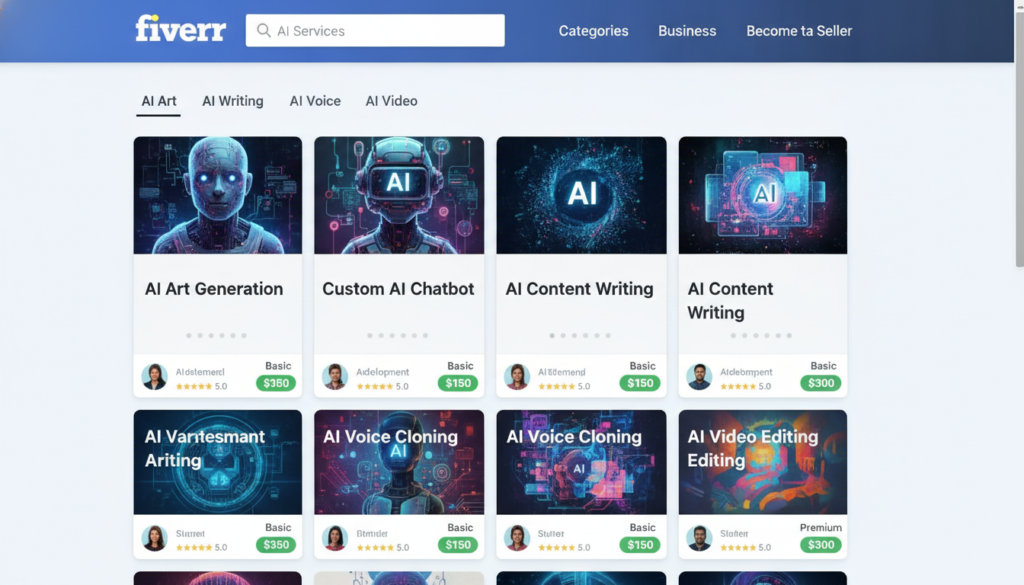
Fiverr
Best for: Standardized service packages and volume sales
- Quick setup and sales
- Package-based pricing
- Large buyer audience
- 20% platform commission
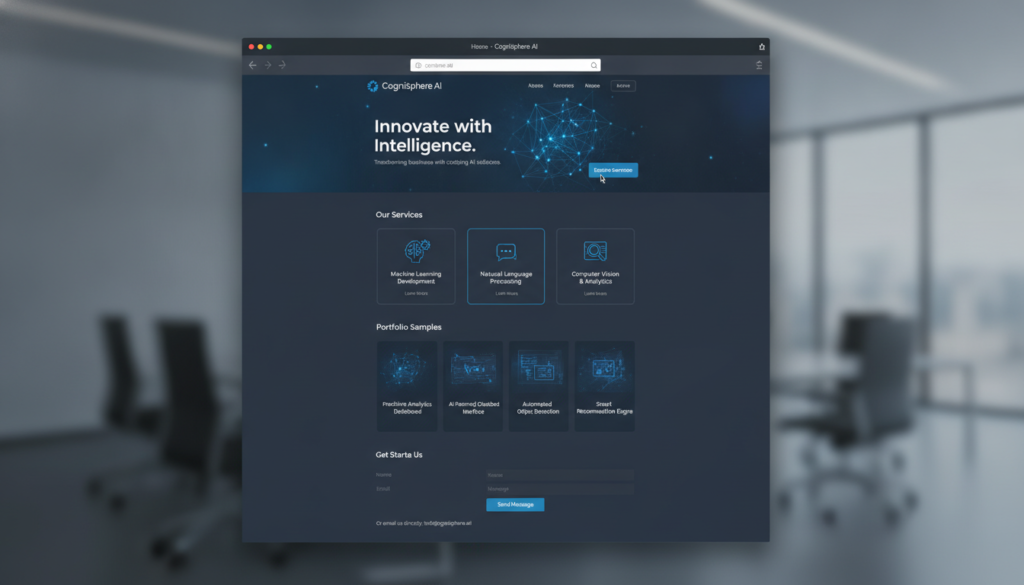
Your Own Website
Best for: Building your brand and keeping 100% of revenue
- No platform fees
- Complete control over pricing
- Build your brand equity
- Own your client relationships
Social Media Platforms for Service Promotion
Instagram works well for visual AI services like image generation and design. You can showcase before-and-after examples, demonstrate AI art capabilities, and attract clients through compelling portfolio posts. Stories and Reels increase visibility and engagement.
Twitter (X) positions you as an AI expert through consistent insights and tips. Share quick wins, tool recommendations, and industry observations. The platform’s professional audience includes decision-makers actively seeking solutions, making it excellent for B2B services.
YouTube creates long-term visibility through tutorial content. Videos demonstrating how you use AI tools to solve problems attract viewers who later become clients. This approach builds authority while creating passive income through ads and affiliate links for the tools you recommend.
TikTok reaches younger business owners and entrepreneurs through short, engaging content. Quick demonstrations of AI capabilities, time-saving tips, and results showcases resonate with this audience. The platform’s algorithm can rapidly grow your following and client base.
Step-by-Step Guide: How to Start Selling AI Services
Starting your AI services business doesn’t require massive investment or years of preparation. Following a structured approach gets you earning money within weeks while building a foundation for long-term growth. These steps take you from complete beginner to paid service provider.
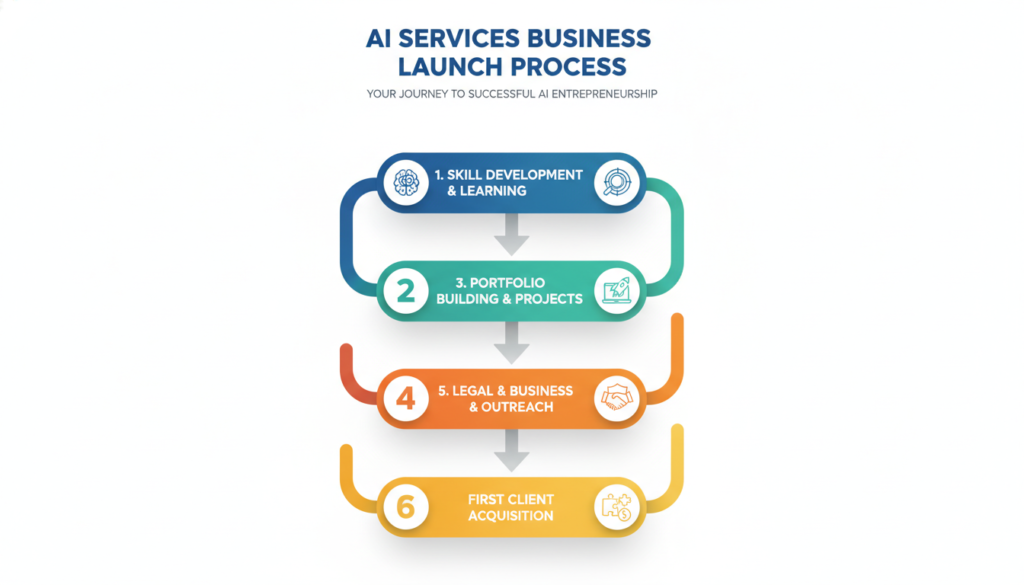
Step 1: Choose Your AI Service Niche
Selecting a specific focus prevents overwhelm and accelerates your learning. Review the profitable services discussed earlier and choose one that aligns with your interests and target market. Content creation offers the lowest barrier to entry, while automation services command higher prices but require more technical comfort.
Research demand for your chosen niche by browsing freelance platforms and job boards. Search for relevant keywords and note how many opportunities appear, what clients are willing to pay, and what skills they request. High demand with reasonable competition indicates a viable niche.
Consider your existing skills and background. Former marketing professionals naturally excel at content and social media services. People with analytical backgrounds gravitate toward data services. Leveraging what you already know shortens your learning curve and builds confidence faster.
Step 2: Master Essential AI Tools
You don’t need to learn every AI tool available. Focus on the specific platforms relevant to your chosen service. Content creators need tools like ChatGPT, Claude, or Jasper. Image services require Midjourney or DALL-E. Automation specialists work with Zapier, Make, or n8n with AI integrations.
Dedicate 2-3 weeks to intensive practice with your primary tools. Complete official tutorials, watch YouTube guides, and most importantly, create practice projects. The difference between knowing about tools and using them effectively comes through hands-on experience.
Join tool-specific communities and forums. Users share prompts, workflows, and best practices that accelerate your learning. Many tools offer free tiers or trials, allowing you to develop skills without upfront costs. Invest in paid plans only after securing your first clients.
Document your learning process by creating templates and systems. Save effective prompts, record successful workflows, and build your personal knowledge base. These resources become valuable assets that speed up client delivery and can even become digital products you sell later.
Step 3: Build Your Portfolio
Clients won’t hire you without seeing examples of your work. Create a portfolio even before landing your first paying client by developing spec projects that demonstrate your capabilities. Quality samples prove you can deliver results.
For content services, write 3-5 sample articles in industries you want to target. Optimize them for SEO, make them genuinely useful, and showcase them on your website or LinkedIn profile. Real value in your samples impresses potential clients more than flashy presentations.
Visual service providers should create diverse examples showing range and quality. Generate collections of AI art in different styles, create social media graphics for imaginary brands, or develop video samples. Variety demonstrates flexibility while maintaining consistent quality standards.
Automation and technical services benefit from video demonstrations. Record screen captures showing workflows you’ve built, explaining the problem solved and time saved. Before-and-after comparisons make your value immediately clear to prospects evaluating your services.
Consider offering your first few services at discounted rates or even free in exchange for testimonials and case studies. Real client results with measurable outcomes create far more compelling portfolio pieces than spec work. Document everything to use in future marketing.
Step 4: Set Up Your Business Presence
Establish basic business infrastructure before actively seeking clients. This doesn’t require significant investment but provides the professional appearance that builds trust and credibility. Start with essentials and expand as revenue grows.
Create professional profiles on your chosen platforms. Use a quality headshot, write clear service descriptions, and highlight specific outcomes you deliver. Avoid generic descriptions like “AI expert” and instead specify “AI chatbot implementation that reduces customer service costs by 40%.”
Set up a simple website using platforms like Wix, WordPress, or Carrd. Include pages for services offered, portfolio examples, pricing information, and contact details. Your site doesn’t need complexity, just clear communication of what you offer and why clients should hire you.
Establish payment systems before closing your first deal. PayPal, Stripe, or platform-integrated payment processors handle transactions securely. Decide whether you’ll invoice clients directly or rely on marketplace payment systems. Having this ready prevents delays when clients want to move forward.
Create standard documents including service agreements, project briefs, and questionnaires for new clients. Templates save time and present a professional image. You can find free contract templates online and customize them for your specific services and terms.
Launch Your AI Services Business Faster
Get our complete AI Services Business Blueprint including done-for-you templates, contracts, pricing calculators, and client onboarding systems. Everything you need to start earning within 30 days.
Step 5: Land Your First Clients
Your first clients validate your business concept and provide crucial feedback. Start with easier acquisition channels before investing heavily in marketing. Early wins build momentum and confidence.
Network within your existing connections first. Inform friends, family, and professional contacts about your new services. Many people know business owners who need exactly what you offer. Personal referrals convert at higher rates than cold outreach.
Apply strategically to jobs on freelance platforms. Customize each proposal to address the specific client’s needs rather than sending generic pitches. Demonstrate you’ve read their requirements carefully and explain your unique approach to solving their problem.
Offer a special introductory rate or package to your first 5-10 clients. This reduces their risk and increases conversion rates. In exchange, request detailed testimonials, permission to create case studies, and referrals to others who might need services. These assets become marketing tools for attracting future clients at full rates.
Follow up persistently but professionally. Many proposals receive responses days or weeks later. Create a system for tracking outreach and scheduling follow-ups. Consistent presence without being pushy keeps you top-of-mind when clients are ready to move forward.
Step 6: Deliver Exceptional Results
Your reputation determines long-term success more than any marketing tactic. Delivering outstanding results to early clients creates word-of-mouth referrals, repeat business, and testimonials that sell future services. Over-deliver initially to build a strong foundation.
Set clear expectations with every client before starting work. Define deliverables, timelines, revision policies, and success metrics. Written agreements prevent misunderstandings and provide protection for both parties. Clear communication eliminates most potential conflicts.
Maintain regular communication throughout projects. Update clients on progress, ask clarifying questions promptly, and address concerns immediately. Ghosting or delayed responses destroy trust faster than any service quality issue. Responsiveness differentiates you from competitors.
Exceed deadlines when possible and deliver more than promised. If you quote 5 business days, deliver in 4. If you commit to 10 images, provide 12. Small extras create delighted clients who become enthusiastic promoters of your services.
Request feedback and testimonials immediately after successful project completion. Clients are most enthusiastic when they’ve just received great results. Ask specific questions about measurable outcomes, their experience working with you, and what problems you solved. Detailed testimonials convert future prospects better than generic praise.
Step 7: Scale and Systematize
Once you’ve delivered successful projects, focus on building systems that allow growth without proportionally increasing your time investment. Scalability transforms a freelance side hustle into a real business that generates substantial income.
Document your processes for every service you offer. Create checklists, templates, and standard operating procedures. This documentation allows you to work faster, maintain consistent quality, and eventually train others to handle delivery while you focus on business development.
Raise your prices as demand increases. When you’re fully booked, it signals your rates are too low. Gradual price increases attract better clients while maintaining profitability. Test 10-20% increases and monitor how it affects demand. Most providers undercharge significantly at first.
Consider building passive income streams alongside service work. Package your knowledge into online courses, create templates and tools to sell, or develop AI-powered products. Diversifying income sources beyond trading time for money creates more sustainable business models.
Hire contractors or build a team when client demand exceeds your capacity. Starting with subcontractors for specific tasks preserves cash flow while adding capacity. As revenue grows, bring on dedicated team members to handle delivery while you focus on strategy and growth.
Pricing Strategies for AI Services
Pricing significantly impacts both your income and client perception. Charge too little and you’ll work constantly while struggling financially. Price appropriately and you’ll attract quality clients while building a sustainable business. Understanding different pricing models helps you maximize revenue.
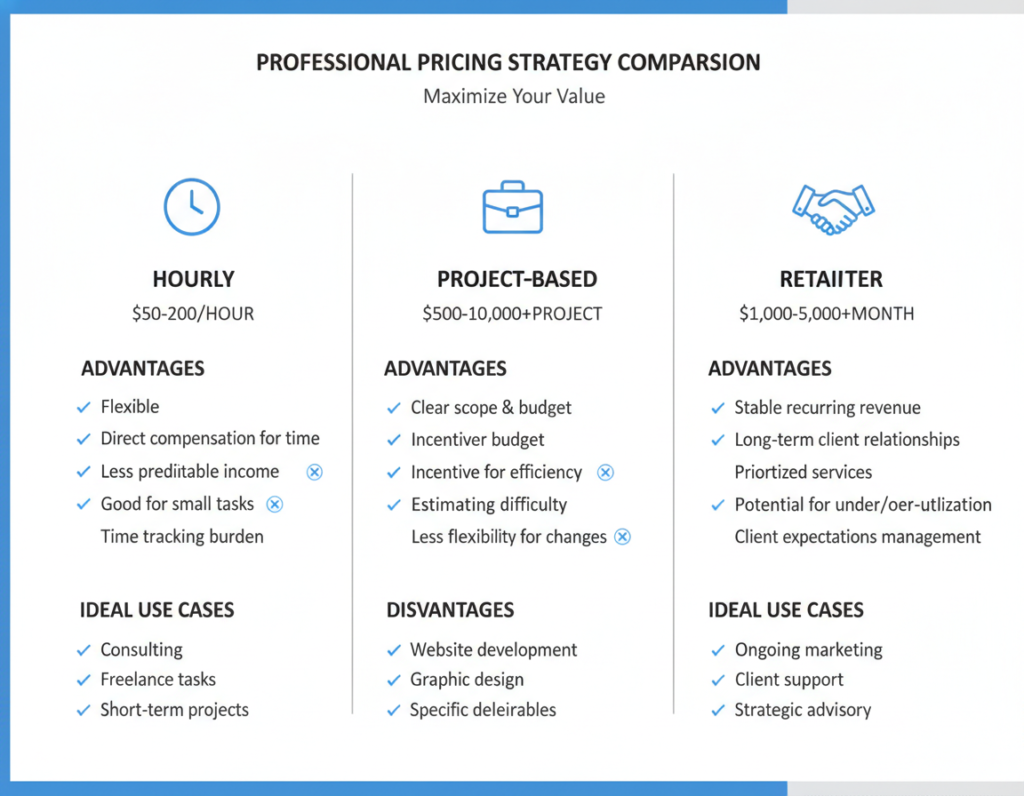
Hourly Rate Pricing
Charging by the hour seems straightforward but often undervalues your expertise. Clients focus on time spent rather than results delivered. However, hourly pricing works well for certain situations, particularly ongoing support and unpredictable scope projects.
Calculate your hourly rate based on desired annual income, not competitor rates. If you want to earn $60,000 annually and work 1,500 billable hours, you need $40 per hour minimum. Add overhead costs, taxes, and desired profit margin to reach your actual rate. Most AI service providers charge $50-150 per hour depending on specialization.
The limitation of hourly pricing becomes apparent as you gain efficiency. Using AI tools, you complete work faster, which paradoxically reduces your income. A task that once took 10 hours now takes 2, cutting your revenue by 80% despite delivering identical value to clients.
Use hourly rates primarily for maintenance work, ongoing consulting, or situations where project scope remains unclear. For defined deliverables like “write 10 blog posts” or “set up chatbot system,” value-based or project pricing generates better income.
Project-Based Pricing
Flat project rates align your interests with clients and reward efficiency. You quote a fixed price for defined deliverables regardless of time required. This approach allows you to profit from your expertise and tool mastery rather than being penalized for speed.
Price projects based on value delivered, not hours worked. A chatbot that saves a business $2,000 monthly in customer service costs is worth $3,000-5,000 to implement, even if you complete it in 8 hours. The client gets tremendous ROI, and you’re compensated appropriately for the outcome.
Create clear project scopes to avoid scope creep. Define exactly what’s included, how many revision rounds you’ll provide, and what triggers additional charges. Written agreements protect both parties and prevent the “just one more thing” requests that erode profitability.
Build pricing tiers for common services. Offer basic, standard, and premium packages for services you deliver regularly. Tiers accommodate different budgets while guiding clients toward mid-tier options that balance your profit margin with their budget comfort.
| Service Type | Basic Package | Standard Package | Premium Package |
| Blog Content Creation | 5 posts, basic research ($500-800) | 10 posts, deep research, SEO ($1,200-1,800) | 20 posts, research, SEO, graphics ($2,500-4,000) |
| Chatbot Implementation | Basic FAQ bot ($800-1,200) | Advanced bot with lead capture ($1,800-2,800) | Full system with CRM integration ($4,000-7,000) |
| Social Media Management | 2 platforms, 15 posts/month ($400-600) | 3 platforms, 30 posts/month ($900-1,400) | 4+ platforms, 60 posts, community management ($2,000-3,500) |
| Data Analysis Reports | Single report with insights ($600-1,000) | Monthly reports with recommendations ($1,500-2,500) | Weekly analysis, predictive modeling ($4,000-8,000) |
Retainer and Subscription Models
Monthly retainers provide the holy grail of freelancing: predictable recurring revenue. Clients pay a set monthly fee for ongoing services or guaranteed availability. This model creates passive income streams that continue month after month.
Retainers work exceptionally well for services businesses need consistently. Social media management, ongoing content creation, chatbot maintenance, and marketing automation all fit naturally into monthly arrangements. Clients appreciate budget predictability while you enjoy income stability.
Structure retainers with clear deliverables or hour banks. Either specify what’s included monthly (“30 social posts, 4 blog articles, weekly reports”) or provide a set number of hours (“20 hours of AI services monthly”). Roll-over policies for unused services vary, so establish terms upfront.
Price retainers at a slight discount compared to project rates to incentivize commitment. If your project rate for 20 hours of work is $2,000, offer a monthly retainer at $1,800. The client saves 10% while you gain predictable income and reduced sales effort.
Implement minimum commitment periods of 3-6 months to prevent clients from canceling after you’ve invested in understanding their business. Longer commitments justify setup time and create stability. Offer month-to-month options at higher rates for clients unwilling to commit.
Value-Based Pricing
Value-based pricing represents the ultimate approach for experienced providers. You charge based on the monetary value you create rather than time or deliverables. This requires understanding client economics and confidently articulating your impact.
Calculate the financial impact of your services for the client. If your automation saves them 20 hours weekly at an average wage of $25/hour, that’s $26,000 in annual savings. Charging $5,000-10,000 for implementation delivers massive ROI while providing you excellent compensation for perhaps 30 hours of work.
This approach works best with business clients who think in terms of ROI rather than costs. Enterprise and mid-market companies understand value-based pricing. Small business owners sometimes struggle with this concept, though education can help them see the logic.
Develop case studies showing measurable results to support value-based pricing. “Increased client sales by 40%” or “Reduced support costs by $3,000 monthly” justify premium rates. Results-focused marketing attracts clients who care about outcomes rather than just checking boxes cheaply.
Avoiding Common Pricing Mistakes
Underpricing remains the most common mistake new AI service providers make. Fear of losing clients or imposter syndrome drives people to charge far below market rates. This attracts difficult clients while preventing business sustainability. Research market rates and price confidently based on value.
Failing to account for all costs erodes profitability. Beyond your time, factor in tool subscriptions, payment processing fees, platform commissions, taxes, and business expenses. What seems like a good hourly rate quickly becomes unprofitable when real costs are considered.
Not raising prices as you gain experience leaves money on the table. Your skills, speed, and results improve over time. Annual price increases of 10-20% ensure your rates match your growing expertise. Grandfather existing clients at current rates while charging new clients higher amounts.
Offering unlimited revisions encourages scope creep and client indecision. Include 2-3 revision rounds in your pricing and charge for additional changes. This motivates clients to provide clear direction initially and respect your time.
How to Market Your AI Services Effectively
Outstanding services mean nothing if potential clients don’t know you exist. Effective marketing connects your capabilities with people actively seeking solutions. You don’t need massive budgets or complex strategies, just consistent effort in the right channels.
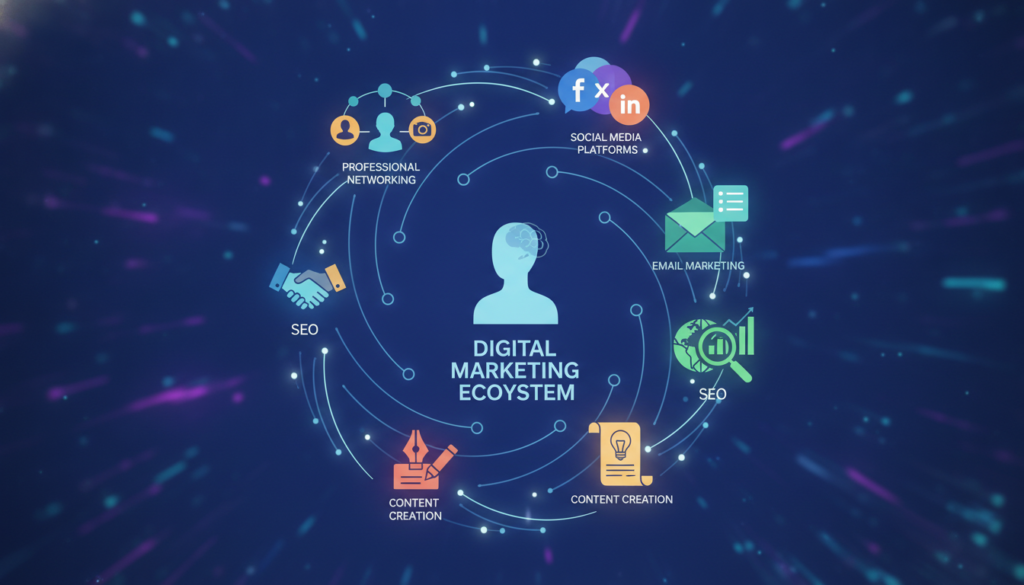
Content Marketing and Thought Leadership
Demonstrating expertise through valuable content positions you as the obvious choice when prospects need services. Content marketing builds authority while creating assets that attract clients continuously without ongoing effort. This approach generates passive income through consistent client acquisition.
Start a blog focused on solving specific problems your target clients face. Write articles like “How to Reduce Customer Service Costs with AI Chatbots” or “5 Ways AI Content Creation Boosts Your Marketing ROI.” Practical, actionable content attracts readers who become clients.
Optimize content for search engines to capture people actively searching for solutions. Research keywords your ideal clients use, include them naturally in your writing, and create truly helpful resources. Blog posts ranking on Google drive qualified traffic month after month.
Create video content for YouTube and social media showing your processes and results. Screen recordings demonstrating how you solve problems, before-and-after comparisons, and tutorial content build trust. Viewers who see you work become confident in hiring you.
Repurpose content across multiple platforms to maximize reach. Turn a blog post into a LinkedIn article, Twitter thread, Instagram carousel, and YouTube video. One piece of content becomes five, multiplying your visibility without proportionally increasing work.
Social Media Marketing for AI Services
Social media platforms provide free access to billions of potential clients. Strategic presence on platforms where your target audience spends time creates awareness and generates leads. Different platforms serve different purposes in your marketing ecosystem.
LinkedIn dominates for B2B AI services. Share insights about industry trends, comment on relevant posts, and connect with decision-makers at target companies. Position yourself as a helpful expert rather than constantly promoting services. Relationships developed through value-first engagement convert into clients.
Instagram showcases visual results for design and content services. Before-and-after images, portfolio pieces, and behind-the-scenes content demonstrate capabilities while building a following. Use Stories to show your daily work and Reels to reach new audiences through algorithm-favored content.
Twitter (X) facilitates conversations with other professionals and potential clients. Share quick tips, industry observations, and engage in relevant discussions. The platform’s text-based nature suits thought leadership and networking. Building genuine relationships leads to referrals and direct business.
Consistency matters more than platform choice. Posting sporadically on five platforms produces worse results than regular presence on one or two. Choose platforms matching your strengths and audience, then commit to consistent value delivery. Daily engagement builds momentum over time.
Email Marketing and Lead Nurturing
Email remains one of the highest-ROI marketing channels. Building an email list creates a direct communication line to interested prospects. Unlike social media where algorithms control visibility, email puts your messages directly into subscriber inboxes.
Offer valuable lead magnets in exchange for email addresses. Create resources like “AI Tools Comparison Guide,” “Content Creation Templates,” or “Automation Workflow Examples.” These assets attract qualified leads already interested in topics related to your services.
Send regular newsletters providing tips, case studies, and insights. Position emails as helpful resources rather than sales pitches. Include soft CTAs inviting readers to reply with questions or book consultation calls. Educational content builds trust that converts to clients when needs arise.
Segment your email list based on interests and engagement. Send targeted messages to subscribers interested in specific services. Someone who downloaded your chatbot guide receives different follow-up content than someone interested in content creation. Relevance increases conversion rates.
Implement automated email sequences for new subscribers. Welcome emails, value-building messages, and eventual sales offers guide people from awareness to client status. Automation creates passive income by converting leads while you focus on delivery and business growth.
Strategic Networking and Partnerships
Relationships with other professionals create referral networks and collaboration opportunities. Building genuine connections in your industry opens doors that no amount of advertising can match. People prefer hiring those they know or who come recommended by trusted sources.
Join online communities where your target clients gather. Participate in Facebook groups, Slack communities, and forums related to your niche. Answer questions, share insights, and build reputation as a helpful expert. Avoid self-promotion; let your expertise speak for itself. Members with needs will reach out.
Attend virtual and in-person networking events in your industry. Conferences, meetups, and workshops connect you with potential clients and referral partners. Follow up with valuable connections, offering help before asking for anything. Relationships built on mutual benefit generate long-term value.
Partner with complementary service providers for referrals. Web designers, marketing agencies, and business consultants serve similar clients but offer different services. Create formal or informal referral arrangements where you send business to each other. These partnerships multiply your reach without additional marketing costs.
Offer affiliate commissions to satisfied clients who refer new business. A 10-15% commission on referred projects incentivizes word-of-mouth marketing. Happy clients already recommend services they love; affiliate programs reward and encourage this behavior.
Free Marketing Strategies
- Content marketing through blogs and videos
- Organic social media engagement
- Community participation and networking
- SEO optimization for existing content
- Email marketing to your list
- Guest posting on industry blogs
- Podcast guesting and interviews
Paid Marketing Strategies
- LinkedIn and Facebook advertising
- Google Ads for high-intent keywords
- Sponsored content and influencer partnerships
- Promoted social media posts
- Platform featured listings (Upwork, Fiverr)
- Retargeting campaigns for website visitors
- YouTube advertising for service demos
Leveraging Client Testimonials and Case Studies
Social proof removes doubt and accelerates purchase decisions. Potential clients want evidence you’ve delivered results for others before risking their money. Detailed testimonials and case studies become your most powerful marketing assets.
Request specific testimonials focusing on measurable outcomes. Generic praise like “great to work with” helps less than “increased our leads by 127% in 60 days.” Ask clients about specific results, their experience working with you, and why they’d recommend your services.
Create detailed case studies for your best client successes. Document the initial challenge, your approach and solution, and quantifiable results. Include quotes, screenshots, and data that prove impact. Prospects seeing similar businesses achieve results become confident you can help them too.
Display testimonials prominently on your website, proposals, and marketing materials. Video testimonials carry even more weight than written ones. Ask satisfied clients to record brief videos describing their experience and results. These authentic endorsements convert skeptics into buyers.
Use success stories in your content marketing. Write blog posts analyzing how you solved specific client problems. This demonstrates expertise while providing social proof. Just ensure you have client permission before sharing details publicly.
Common Challenges and How to Overcome Them
Every business faces obstacles on the path to success. Anticipating common challenges and having strategies to address them prevents discouragement and keeps you moving forward. These solutions help you navigate the predictable difficulties of building an AI services business.
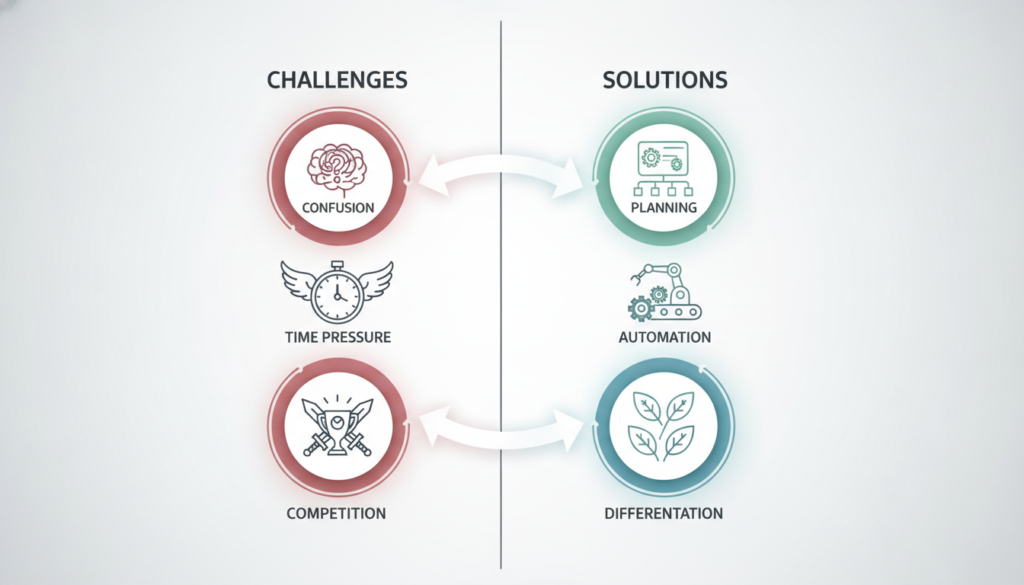
Challenge: Standing Out in a Competitive Market
The low barrier to entry for AI services means competition increases constantly. Anyone can claim to offer AI services, making differentiation critical. Generic positioning as an “AI expert” gets lost in the noise of similar providers.
Solution: Specialize in a specific niche or industry. Instead of offering general content writing, become “the AI content specialist for SaaS companies” or “AI-powered content for real estate agents.” Specificity attracts ideal clients while repelling poor fits. Business owners prefer specialists who understand their unique needs.
Develop a unique methodology or process that differentiates your approach. Name it and explain how it delivers superior results. This intellectual property creates perceived value beyond commodity service delivery. “The ResultsFirst AI Content System” sounds more valuable than “I write blog posts.”
Focus relentlessly on results over processes. Clients don’t care which tools you use or how much time you spend. They want measurable outcomes that improve their business. Market your services based on specific results you deliver, not features or your qualifications.
Challenge: Pricing Uncertainty and Client Budget Resistance
Determining appropriate pricing confuses new service providers. Fear of overcharging loses potential income while underpricing attracts difficult clients and prevents sustainability. Budget-conscious clients push for lower rates regardless of value delivered.
Solution: Develop tiered pricing packages offering options at different price points. This accommodates varying budgets while guiding clients toward profitable mid-tier options. Present three packages with the middle option designed for optimal profit margin and value balance.
Anchor pricing by presenting the premium package first. This makes the standard package seem reasonably priced by comparison. Some clients will choose premium options you might not have offered without tiered pricing, increasing average transaction value.
Educate clients on ROI rather than arguing about rates. When prospects balk at $2,000 for a service, explain the $10,000 in annual value it provides. Shift conversations from cost to investment and return. Business-focused clients understand this language and make decisions accordingly.
Walk away from clients demanding unsustainable rates. Not every prospect becomes a good client. Clients who only care about price typically cause the most problems. Protect your profitability and sanity by pursuing clients who value quality and results.
Challenge: Managing Time and Avoiding Burnout
The hustle to build your business can lead to unsustainable work schedules. Taking on too many clients or underestimating project timelines creates stress and quality issues. Trading all your time for money limits income potential and leads to burnout.
Solution: Implement strict project management and capacity planning. Limit the number of active projects you accept based on realistic delivery timelines. Better to have a waitlist than to overcommit and deliver subpar work or miss deadlines.
Use AI tools not just for client delivery but for your own business operations. Automate administrative tasks, client communication, scheduling, and invoicing. The time saved on business management increases capacity for billable work without working more hours.
Build systems and templates for repeatable tasks. Create standardized onboarding processes, project briefs, contract templates, and delivery workflows. Systems reduce decision fatigue and speed up execution, allowing you to serve more clients in less time.
Schedule regular breaks and maintain boundaries. Working constantly seems productive but reduces creativity and leads to mistakes. Establish working hours and stick to them. Clients respect boundaries when you communicate them clearly and consistently.
Effective Strategies
- Specialized positioning in specific niches
- Results-focused marketing and pricing
- Systematic processes and automation
- Clear boundaries and capacity limits
- Continuous learning and adaptation
- Building referral and partnership networks
Approaches to Avoid
- Trying to serve everyone in every industry
- Competing primarily on price
- Working without systems or planning
- Accepting every client regardless of fit
- Relying on a single client or platform
- Neglecting ongoing skill development
Challenge: Keeping Up with Rapid AI Evolution
Artificial intelligence evolves at breathtaking speed. New tools launch monthly, capabilities expand continuously, and best practices shift rapidly. Staying current feels overwhelming while maintaining client delivery and business operations.
Solution: Allocate dedicated time weekly for learning and experimentation. Block 3-5 hours for exploring new tools, reading industry news, and testing capabilities. Treat professional development as non-negotiable business investment rather than optional activity.
Focus learning on tools and techniques directly relevant to your services. You don’t need expertise in every AI development. Deep knowledge of platforms you actually use serves clients better than surface familiarity with everything available. Specialization beats generalization.
Join AI communities and follow industry leaders who curate information. Subscribe to newsletters like The Rundown AI or Ben’s Bites that summarize weekly developments. This filtered approach provides relevant updates without drowning in information overload.
Communicate continuous improvement to clients as a value proposition. Position yourself as their trusted guide navigating rapid AI evolution. Clients appreciate partners who keep them informed about new opportunities without requiring them to become experts themselves.
Challenge: Dealing with Difficult Clients
Challenging clients appear in every service business. Scope creep, endless revisions, late payments, and unrealistic expectations damage profitability and morale. Learning to handle these situations professionally protects your business and sanity.
Solution: Prevent most problems through clear agreements and communication upfront. Detailed contracts specifying deliverables, revision limits, payment terms, and timelines eliminate ambiguity. Address potential issues before they arise through written policies.
Recognize red flags during initial conversations and decline clients who show warning signs. Prospects who negotiate aggressively, dismiss your expertise, or seem perpetually dissatisfied rarely become good clients. Trust your instincts and politely pass on poor fits.
Address issues immediately when they arise rather than hoping they resolve themselves. If a client requests out-of-scope work, explain why it’s additional and quote the fee. If payment is late, send professional reminders immediately. Clear, firm communication sets boundaries.
Develop the confidence to fire clients who become more trouble than they’re worth. Sometimes relationships don’t work despite good intentions. Freeing yourself from difficult clients creates space for better opportunities. The short-term revenue loss pays long-term dividends in reduced stress.
Future Trends and Opportunities in AI Services for 2026 and Beyond
Understanding where the AI services market is heading helps you position yourself for emerging opportunities. Early movers in new niches capture market share before competition intensifies. These trends represent areas of growing demand and innovation.

Autonomous AI Agents and Task Automation
AI capabilities are evolving from single-task tools to autonomous agents that complete complex multi-step workflows. These systems can plan, execute, and adapt without constant human supervision. Service providers who master agent implementation will command premium rates.
Businesses want AI that handles entire processes rather than individual tasks. Instead of just writing content, future services include AI that researches topics, creates content, optimizes for SEO, schedules publication, and promotes across social media. End-to-end solutions deliver higher value and justify higher pricing.
The opportunity lies in orchestrating multiple AI tools into seamless workflows. You become the architect designing and implementing systems where different AI capabilities work together cohesively. This requires broader understanding than operating individual tools but creates stronger competitive advantages.
Hyper-Personalization Services
Generic content and one-size-fits-all solutions are becoming obsolete. AI enables mass personalization where every customer receives customized experiences. Service providers who can implement personalization strategies will find eager clients in e-commerce, marketing, and customer service sectors.
Email marketing evolves beyond basic segmentation to truly individualized messaging. AI analyzes each recipient’s behavior, preferences, and engagement patterns to craft unique messages. Implementing these sophisticated systems creates recurring revenue opportunities managing ongoing personalization.
Product recommendations, website experiences, and customer interactions all benefit from AI-driven personalization. Businesses see dramatic conversion improvements from personalized approaches but lack expertise to implement them. This gap represents your opportunity to make money delivering these capabilities.
AI Integration and Custom Solutions
As businesses adopt multiple AI tools, integration challenges emerge. Tools that don’t communicate create data silos and inefficiencies. Service providers skilled in connecting AI platforms to existing business systems will find strong demand from growing companies.
Custom AI implementation using APIs and no-code platforms enables tailored solutions beyond off-the-shelf products. Building proprietary AI tools for specific business needs justifies premium pricing while creating ongoing maintenance revenue. Technical confidence with integrations opens high-value opportunities.
The trend toward industry-specific AI solutions creates niches for specialists. Healthcare, legal, finance, and other regulated industries need AI implementations that comply with specific requirements. Developing expertise in one vertical positions you as the go-to expert commanding top rates.
AI Training and Education Services
Demand for AI education grows as adoption accelerates. Businesses want to upskill their teams to use AI effectively. This creates opportunities beyond direct service delivery into training, consulting, and education that generate passive income through courses and workshops.
Corporate training programs teach employees to use AI tools in their specific roles. Marketing teams need AI writing training, customer service departments want chatbot management skills, and operations staff require automation education. Developing industry-specific training programs creates scalable revenue.
Online courses teaching AI skills to entrepreneurs and freelancers represent massive markets. Your expertise delivering client results translates directly into educational products. Courses create passive income while establishing authority that attracts more service clients.
Ethical AI and Responsible Implementation
Growing awareness of AI risks creates demand for ethical implementation guidance. Businesses worry about bias, privacy, transparency, and responsible use. Positioning yourself as an expert in ethical AI practices differentiates you while addressing real client concerns.
Compliance services help businesses navigate evolving AI regulations. As governments implement AI oversight, companies need help ensuring their implementations meet legal requirements. Early expertise in AI compliance and governance positions you for this growing market.
Transparency and explainability services address the “black box” problem of AI decisions. Businesses using AI for important decisions need to explain outcomes to customers and stakeholders. Services that make AI reasoning transparent and defensible add significant value.
Emerging High-Value Niches
- Autonomous agent implementation
- Custom AI integration services
- Industry-specific AI solutions
- AI compliance and governance
- Personalization strategy and implementation
- AI training and education
Skills to Develop Now
- API integration and no-code tools
- Multi-tool workflow orchestration
- Industry vertical expertise
- Ethical AI principles
- Change management and training
- Data privacy and security
Market Opportunities
- Small businesses adopting first AI
- Mid-market companies scaling AI
- Enterprises needing custom solutions
- Individual entrepreneurs and creators
- Educational institutions
- Non-profits and social enterprises
Building a Sustainable AI Services Business
Short-term income feels good, but long-term business sustainability provides real security and freedom. Building systems, diversifying revenue, and creating assets that compound over time transforms freelancing into a genuine business. These strategies move you toward sustainable success.
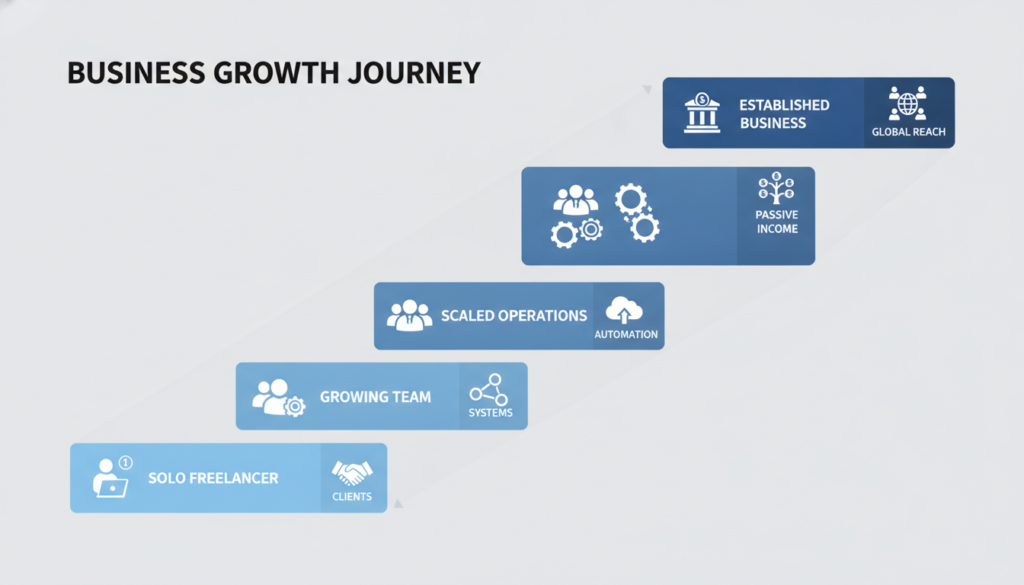
Diversifying Your Revenue Streams
Relying entirely on client services creates income instability. Client budgets change, projects end, and platforms modify policies. Building multiple income sources protects against these fluctuations while increasing total earnings beyond time-based limitations.
Develop digital products that generate passive income alongside services. Templates, prompts, mini-courses, and tools related to your expertise sell repeatedly without additional delivery work. A $47 product selling 20 times monthly adds $940 in passive income requiring minimal ongoing effort.
Create affiliate income by recommending tools you use and trust. Most AI platforms offer affiliate programs paying commissions on referrals. Since you already recommend tools to clients and in content, adding affiliate links monetizes these recommendations without changing your behavior.
Build online courses teaching your AI service skills. Package your knowledge into structured programs priced from $97-997. Courses scale infinitely, selling to hundreds or thousands of students while you focus on high-value client work. This creates real passive income potential.
Consider subscription offerings providing ongoing value. Premium newsletters, community access, monthly templates, or “office hours” consultations create recurring revenue. Even 50 subscribers at $29 monthly generates $1,450 in predictable income.
Building Systems and Documentation
Documented processes create consistency, speed up delivery, and enable scaling. Every repeated task should eventually have a standard operating procedure. Systems free you from constantly reinventing approaches while maintaining quality.
Create templates for common deliverables. Standard formats for blog posts, social media content, proposals, and reports speed production while ensuring consistency. You work faster and clients receive reliably excellent results. Templates also enable hiring others to handle delivery eventually.
Document your workflows from client acquisition through project completion. How do you qualify leads? What’s your onboarding process? How do you gather requirements and deliver results? Written procedures allow delegation and create valuable business assets.
Build a knowledge base of effective prompts, successful strategies, and solutions to common problems. This personal wiki becomes increasingly valuable as it grows. You solve problems faster, deliver better results, and could eventually package this knowledge into paid products.
Strategic Growth and Scaling
Sustainable growth requires intentional planning rather than just accepting every opportunity. Strategic decisions about which clients to pursue, what services to offer, and how to invest resources determine long-term success.
Regularly evaluate your service portfolio and eliminate low-margin offerings. Not all services deserve continued focus. Concentrate on activities delivering the best combination of revenue, enjoyment, and strategic value. Saying no to mediocre opportunities creates space for excellent ones.
Invest in your skills and tools as revenue grows. Paid AI platforms often deliver better results than free tiers. Advanced training improves your capabilities and justifies higher rates. View these expenses as business investments generating returns through better service delivery.
Build relationships with other service providers for collaboration and referrals. Joint ventures on larger projects expand your capabilities without permanent hiring. Referral partnerships with complementary providers create steady client flow. Strategic relationships multiply your reach and capacity.
Consider hiring contractors or employees when demand consistently exceeds your capacity. Starting with project-based contractors minimizes risk while adding capability. As revenue stabilizes, dedicated team members allow you to focus on strategy while others handle delivery and operations.
Sustainability Mindset: Build your business for the long term by making decisions that compound value over time. Focus on reputation, relationships, and systems rather than just immediate revenue. Quick money feels good today, but sustainable business provides freedom for years to come.
Creating Passive Income Assets
True business sustainability comes from assets that generate income without your direct involvement. While active service delivery provides immediate cash flow, passive assets create freedom and optionality for your future.
Your content library becomes a passive income asset. Blog posts and videos ranking in search results drive traffic and leads months or years after creation. One excellent piece of content can generate dozens of clients over time without additional promotion effort.
Email lists represent owned audiences you can monetize repeatedly. Unlike social media followers controlled by platforms, email subscribers provide direct access. An engaged list of 5,000 people creates significant value through product launches, affiliate promotions, and service offerings.
Digital products and courses sell continuously through automated funnels. Create them once, set up payment processing and delivery automation, and they generate income while you sleep. This passive income provides buffer during slow periods and funds for business investment.
Retainer client bases create predictable recurring revenue approaching passive income. While you provide ongoing value, retainers require less active sales effort than constantly finding new projects. Stable monthly income from 5-10 retainer clients funds business operations and growth.
Measuring Success and Continuous Improvement
Track key metrics beyond just revenue to understand business health and identify improvement opportunities. Data-driven decisions beat assumptions and gut feelings. Regular analysis reveals patterns guiding smarter strategic choices.
Monitor client acquisition cost and lifetime value. Understanding how much you spend acquiring clients and how much they spend over time informs marketing budget decisions. If average client value is $5,000 and acquisition costs $200, you can invest aggressively in marketing.
Track income sources and profit margins by service type. Some offerings generate more profit than others despite similar revenue. Focus energy on high-margin services while eliminating or repricing low-margin work. This simple analysis can dramatically improve profitability.
Measure client satisfaction through feedback and referral rates. Happy clients provide testimonials, referrals, and repeat business. If satisfaction metrics decline, investigate and address issues before they impact your reputation and revenue.
Set quarterly goals and review progress regularly. Where do you want your business in three months, six months, one year? Define specific targets for revenue, clients, products launched, and content created. Regular reviews keep you accountable and allow course corrections.
Your Path to Profitable AI Services Success
The opportunity to make money selling AI services has never been stronger. Businesses across every industry urgently need the capabilities you can provide. The tools exist to deliver professional results without technical degrees or massive investment. Your success depends entirely on taking action.
Start by choosing one service area and mastering the essential tools. Build a small portfolio demonstrating your capabilities. Create professional presence on appropriate platforms. Then begin reaching out to potential clients with confidence in the value you provide.

Price your services based on value delivered, not hours worked. Charge appropriately for the outcomes you create. Invest earnings back into improving your skills and systems. Build relationships with clients and partners who create recurring opportunities.
Marketing focuses on demonstrating results and building trust. Share valuable content consistently. Show real examples of problems solved. Position yourself as the guide helping businesses navigate AI adoption successfully. Clients choose providers they trust over those with the cheapest rates.
Expect challenges along the way. Competition exists, but specialization and quality create differentiation. Difficult clients happen, but clear agreements and boundaries minimize issues. Technology evolves constantly, but focused learning keeps you current. Every obstacle has solutions when you’re committed to success.
The sustainable path combines service delivery with passive income assets. Create templates and digital products. Build an audience through content. Develop systems that allow scaling. Diversify revenue sources to protect against market changes. Think beyond just trading time for money.
Remember that everyone successful today started exactly where you are now. They didn’t have special advantages or secret knowledge. They simply learned the necessary skills, took consistent action, and persisted through early challenges. You can absolutely do the same.
The AI revolution creates historic opportunities for ordinary people to build extraordinary income streams. Businesses desperately need the services you can learn to provide. The question isn’t whether opportunity exists. The question is whether you’ll seize it.
Start today. Choose your service focus, begin learning the tools, and create your first portfolio pieces. In 30 days, you could have paying clients. In 90 days, you could replace your current income. In one year, you could have a thriving business providing freedom and security.
Your AI services success story begins with the decision to take the first step. Make that decision now, and let 2026 be the year you transform your financial future through the massive opportunity in selling AI services.
Launch Your AI Services Business Today
Get the complete 2026 AI Services Success Package including business templates, pricing calculators, client contracts, marketing systems, and step-by-step launch roadmap. Everything you need to start earning within 30 days.
Join 15,000+ entrepreneurs building profitable AI service businesses