
The supplied SERP excerpts contain no readable article body, so CTA details cannot be verified directly. The URLs show three B2C review pages about the framework laptop 13. Their likely search purpose is commercial investigation: readers want an independent view before choosing a laptop.
The strongest competing strategy is a trust-first review. Explain the product, show who it suits, name its limits, compare realistic alternatives, and place helpful purchase links after the reader has enough context. Use clear disclosures and calm language rather than pressure.
Audience: B2C readers, mainly cold and warm prospects researching a laptop.
Need: They want honest information about performance, battery life, display quality, repairability, ports, price, and long-term value.
Product familiarity: Low to medium. They may know the Framework name but need help comparing a framework laptop with other laptops.
Main objection: The laptop may cost more than a standard model, and readers may question battery life, build quality, or whether the diy edition is worth the extra work.
- Review-page CTA pattern: The likely goal of the ranking pages is to help readers assess a framework laptop before purchase. A useful CTA should appear after evidence, not before it.
- Trust-first placement: Put the first product link after the quick verdict and key facts. This serves readers who are ready while allowing other readers to continue.
- Decision-stage placement: Place comparison buttons after the pros and cons, battery discussion, and alternative models. These readers have stronger buying intent.
- Low-pressure language: Use “Check the current configuration” or “See today’s price” instead of “Buy now.” The action matches the reader’s need and avoids an unsupported promise.
- Audience alignment: Cold readers need education and comparisons. Warm readers need price, configuration, warranty, and availability details. Use different CTA text for each stage.
- Offer alignment: The main offer is a product page. A secondary offer can be a simple review checklist or email guide, but it should not interrupt the purchase path.
- Conversion lesson: Honest limits can increase clicks because they reduce doubt. Explain who should not choose the product before asking readers to visit a seller.
A review can sound polished and still fail. Many pages list features, praise every detail, and hide the weak points. Readers notice. They leave before clicking.
The Honest Review Framework gives you a better path. You explain what a product does, where it works well, and where it may disappoint. You help the reader make a safe choice. That trust can turn into better clicks and stronger sales.
What the SERP Reveals About Review CTAs
The three supplied ranking pages focus on the framework laptop 13. One is a personal three-month review. Another is a specialist review. The third is a major technology publication review. This mix suggests that Google values first-hand detail, practical testing, and clear buying guidance for this query.
Personal review
The three-month Framework 13 review is likely aimed at readers who want lived experience. Its audience is B2C and mostly warm. The natural CTA is a product-page visit after the writer explains daily use, battery, keyboard, and issues.
Specialist review
The PCWorld review serves readers who want technical detail. Its CTA is likely a commercial link or retailer path. The best format for this audience is a quiet button near pricing, configurations, and the final score.
Independent review
The Brooks Review page may attract readers who value an independent opinion. Its likely CTA audience is cautious but interested. A comparison link works better than an aggressive purchase command.
Because the supplied HTML text is empty, do not claim that these pages use a specific CTA unless you inspect the live pages. Instead, use their shared topic and format as strategic clues. A competing article should make its CTA easier to understand, more transparent, and more closely tied to each reader’s next question.
Start with the reader’s question
Before adding an affiliate link, ask what the reader needs to decide next: features, price, configuration, or an alternative.
What Is the Honest Review Framework?
The Honest Review Framework is a repeatable method for writing product reviews that are useful, accurate, and conversion-focused. It has six simple parts:
- Understand the product and the reader.
- Check facts from reliable sources.
- Test or evaluate the product against real needs.
- Show benefits and limits with equal care.
- Compare alternatives and explain value.
- Recommend the next step without pressure.
This method works for affiliate content about a laptop, software, course, camera, or service. The product changes. The trust rules do not.
Key idea: Your job is not to make every reader buy. Your job is to help the right reader choose with confidence.
Why honesty improves conversions
Trust reduces doubt. When readers see a fair review, they spend more time on the page. They also understand why a product may fit their needs. A clear recommendation feels like help, not a sales trick.
Honesty also protects your brand. Do not invent a test, claim personal use, or promise results you cannot prove. If you did not use the product, say that you reviewed public specifications, expert tests, and verified user feedback.
Match the Review to Buyer Intent
Search intent tells you what the reader wants now. A person searching “framework laptop 13 battery life” needs a focused answer. A person searching “Framework 13 review” wants a complete decision guide. Your CTA should match that stage.
- Needs a product overview.
- Wants simple feature explanations.
- Responds to a comparison guide.
Cold reader
- Checks battery, display, cpu, ram, and price.
- Wants pros, cons, and real use cases.
- Responds to a configuration link.
Warm reader
- Has chosen a model.
- Needs current stock, price, and warranty details.
- Responds to “See the current option.”
Hot reader
Use the main keyword in the H1, introduction, one H2, one H3, the meta description, and one image alt text. Add related terms naturally. Do not force every phrase into one paragraph.
Use specific questions as subheadings
- How long does the battery last?
- Is the display good for work or school?
- Can you upgrade the ram and ssd?
- Does the keyboard feel comfortable?
- Who should choose the diy edition?
Research the Product Before You Write
Good affiliate content begins before the first sentence. Make a fact sheet for the model you plan to review. Record the source and date for every important claim.
- Visit the official product website and save the current specifications.
- Check the processor, gpu, ram, ssd, storage, display, ports, camera, microphone, and operating system.
- Read independent tests for battery life, heat, sound, screen brightness, and performance.
- Look for repeated user issues, but separate a pattern from one complaint.
- Record the price and explain which configuration it describes.
Image concept: a research board that shows how facts support an honest review.
Do not confuse specifications with benefits
A specification is a fact. A benefit explains why that fact matters. For example, “16 GB of ram” is a specification. “16 GB of ram can help you keep many browser tabs open” is a benefit. Keep both parts clear.
Separate verified facts from judgment
- Use “The product includes” for verified specifications.
- Use “In testing” only when you or a named source performed the test.
- Use “This may suit you” for a reasonable recommendation.
- Use “Check the current listing” when price or stock may change.
Build a Review Structure Readers Can Scan
A strong review lets readers find answers quickly. Use short paragraphs, descriptive headings, bullets, and a verdict near the beginning. Then provide the evidence behind that verdict.
Product overview
Name the model, main use, operating system, and audience. Explain whether it is a standard laptop or a diy edition that needs parts or setup.
Daily experience
Discuss the keyboard, key travel, trackpad, screen, bezel, camera, microphone, sound, ports, and power button. Connect each feature to work, school, travel, or creative tasks.
Value and verdict
Explain price, repairability, upgrade choices, and who should buy. Include alternatives for readers with different needs.
Use a quick rating with written proof
Only publish scores that your evidence supports. A rating without reasons looks like decoration. A rating with clear limits helps readers decide.
Show Benefits, Drawbacks, and Use Cases
Readers trust a review that makes room for both sides. Do not hide issues in a final sentence. Put important drawbacks near the related benefit so the reader sees the difference.
Possible strengths to investigate
- Upgrade options for ram, ssd, or storage.
- Replaceable parts and repair-friendly design.
- Useful selection of ports.
- Comfortable keyboard and clear display.
Possible limits to verify
- Price may rise with added parts.
- Battery performance can vary by model and use.
- The diy edition may take time to put together.
- Gaming performance may be limited without a strong gpu.
Explain who should and should not buy
Good fit
- You want a repairable laptop.
- You like choosing your own ram and ssd.
- You need a flexible work or school computer.
- You value long-term parts support.
Look elsewhere if
- You need the longest possible battery life.
- You want a gaming-first laptop.
- You dislike basic setup tasks.
- You need a very low launch price.

Image concept: evaluate the parts readers use every day, not just the specification sheet.
Compare Alternatives Without Creating Confusion
A comparison helps readers who are not yet ready to click. Choose alternatives based on needs, not on a desire to make one product look perfect.
| Reader need | What to compare | Helpful CTA |
| Repairability | Replaceable parts, upgrade path, and support | Check the modular configuration |
| Travel | Weight, charger size, screen, and battery life | Review travel-ready options |
| Study or office work | Keyboard, camera, microphone, ports, and cpu | See the current model |
| Gaming or editing | Gpu, cooling, screen refresh rate, and storage | Compare performance details |
State when an alternative is better. This may reduce one click today, but it increases trust and can bring the reader back for another recommendation. Product comparisons should help the person, not trap the person.
Make the next click useful
Link to the exact product, model, or configuration discussed. Tell readers what they will find after clicking.
Place Affiliate Links Naturally and Ethically
A good CTA feels like a helpful next step. It does not interrupt every paragraph. Use one main action for each stage of the review.
- Early CTA: Place a small link after the quick verdict for hot readers.
- Evidence CTA: Add a button after specifications, testing, and pros and cons.
- Comparison CTA: Place links after explaining who should choose an alternative.
- Final CTA: Repeat the best next step after the verdict.
Weak CTA versus honest CTA
Weak promotional copy
“This is the best laptop ever. Buy it now before it is gone!”
It uses an unsupported claim, creates pressure, and does not explain where the button leads.
Conversion-focused copy
“If repairability and upgrade options matter most to you, check the current Framework 13 configuration and price.”
It identifies the right reader and sets a clear expectation.
Use button text that describes the action. “See current price,” “Check available ports,” and “Compare configurations” are stronger than “Click here.” Do not promise a discount unless the offer is confirmed and current.
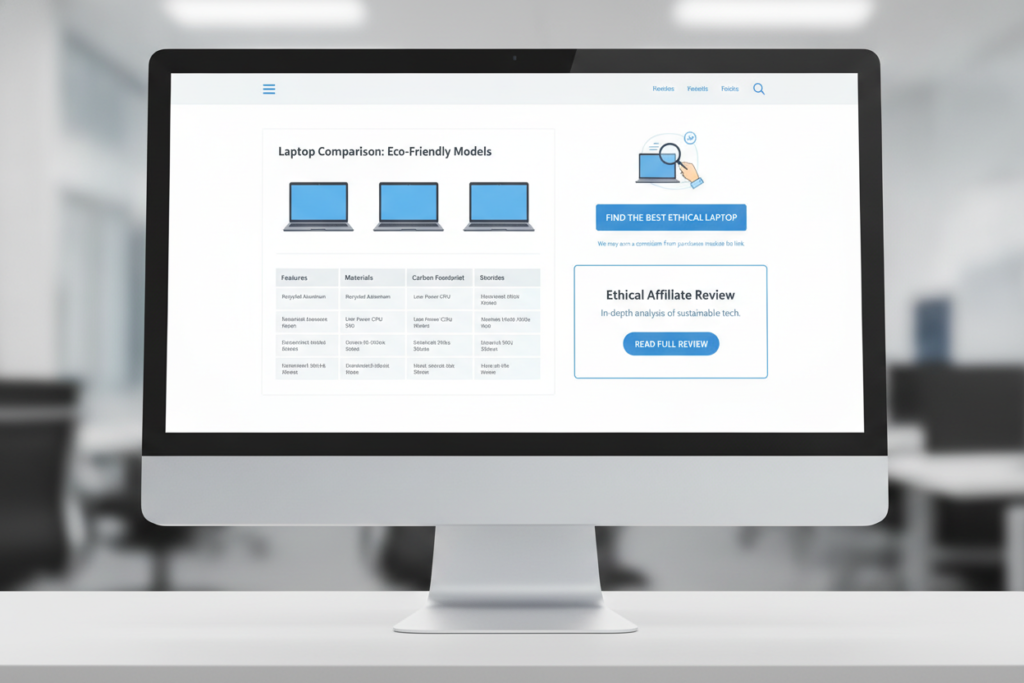
Image concept: a clear CTA placed beside the information needed to make a decision.
Protect Trust With Disclosure and Accuracy
Place an affiliate disclosure near the beginning of the article. Use plain words. Tell readers that you may earn a commission if they buy through a link, at no extra cost to them.
“This review may contain affiliate links. If you buy through one, we may earn a commission at no extra cost to you. Our opinions are based on research and usefulness, not the commission.”
Keep the disclosure visible on mobile. Do not hide it in a footer or use pale text. Also explain whether you tested the product, used a sample, reviewed public specifications, or studied independent tests.
Accuracy rules for affiliate content
- Check the current price before publishing.
- Use the exact model name and configuration.
- Explain that battery results change with brightness, apps, and settings.
- Do not call a product “perfect,” “risk-free,” or “guaranteed” without proof.
- Update broken links, old prices, and changed specifications.
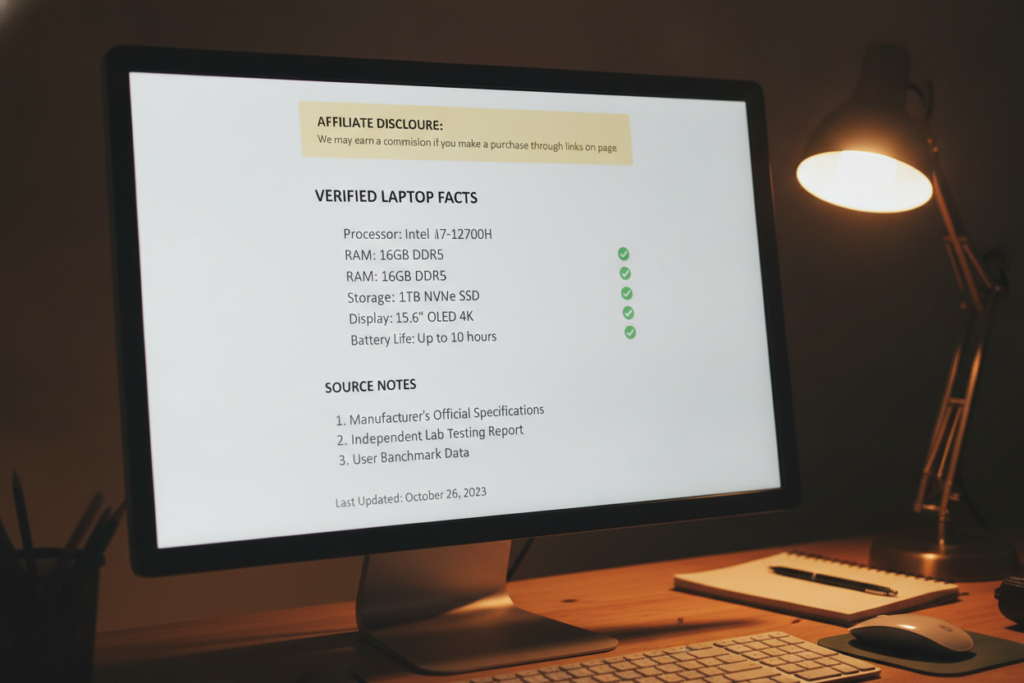
Image concept: transparency makes the commercial relationship easy to understand.
Optimize for SEO Without Writing for Robots
Search engines want content that solves the reader’s problem. Start with the question behind the keyword. Then organize the answer so a reader can scan it in seconds.
On-page basics
- Use one clear H1.
- Write a useful meta description.
- Place the main keyword naturally.
- Use related terms in headings.
Helpful depth
- Answer battery and price questions.
- Explain display, cpu, ram, and ssd.
- Cover ports, keyboard, camera, and sound.
- Include alternatives.
Better experience
- Use short paragraphs.
- Add descriptive image alt text.
- Link to trusted sources.
- Update the review over time.
Build useful internal links
Link to related pages such as a laptop buying guide, a battery care guide, a comparison of storage options, or an explanation of cpu performance. Use descriptive anchor text. Avoid repeating the same link with vague words.
Images should support the review. Use a product view, a testing scene, a comparison graphic, and a disclosure example. Compress each image and write alt text for people who cannot see it.
Common Mistakes That Hurt Trust and Clicks
- Feature dumping: A long specification list does not explain what the product feels like in daily use.
- One-sided praise: Hiding drawbacks makes the recommendation less believable.
- Fake experience: Never say “I tested it” when you did not.
- Vague links: Readers should know whether a button opens a product page, comparison, or retailer.
- Too many buttons: Several competing actions create hesitation.
- Old information: Price, ports, windows support, and available models can change.
- Keyword stuffing: Repeating “laptop” and “framework laptop” can make the page hard to read.
- Missing alternatives: Some readers need a different battery, gpu, screen, or price.
Before publishing: Remove any claim you cannot prove. A smaller, accurate review is better than a larger page filled with guesses.
Use This Honest Review Framework Checklist
- Did you identify the reader and search intent?
- Did you verify the model, price, ram, ssd, storage, cpu, and gpu?
- Did you explain display, keyboard, trackpad, ports, camera, microphone, and sound?
- Did you discuss battery life with a source or clear testing method?
- Did you show useful benefits and honest drawbacks?
- Did you explain who should and should not buy?
- Did you compare at least one suitable alternative?
- Did you disclose affiliate links near the beginning?
- Does each CTA describe a useful next action?
- Does every product link open the correct page in a new window?
- Did you avoid unsupported promises and fake personal experience?
- Did you proofread for simple language and short paragraphs?
Get the review ready to publish
Use this checklist before every affiliate review. It keeps your facts clear, your links useful, and your recommendation honest.
Final Verdict: Help First, Convert Second
The best affiliate review does not force a sale. It gives readers enough useful information to choose with confidence. That means clear facts, real benefits, fair limits, useful comparisons, and a visible disclosure.
Use the Honest Review Framework each time you create affiliate content. Research the product, match the reader’s intent, explain the details in plain English, and place a calm CTA where it answers the next question.
Your next step is simple: choose one product, build the checklist, verify every claim, and add one helpful link to the exact configuration your reader may need.