
Your client may love a new logo, website, or social media kit. Yet the work may stop before the brand reaches the street, office, shop, or delivery box. That gap is a clear opportunity.
Upselling real-world assets to design clients means helping a customer turn digital brand work into useful physical items. Think of signage and logos, printed branding, vehicle graphics, packaging, displays, and office signs. You create more value for the customer while building a stronger product service offer for your own business.
This guide shows you how to spot the opportunity, present it with care, price it clearly, and work with production partners.
What the Top Pages Teach You About CTA Strategy
The pages ranking for broad upselling searches usually teach before they sell. That choice matters. A reader searching for an explanation may not be ready to buy. They first want information, examples, and a safe next step.
Salesforce: education that supports a sales conversation
Salesforce targets business teams, sales leaders, and customer success professionals. Its primary goal is to inform, with a secondary goal of moving qualified readers toward a business product or sales conversation. The audience is B2B and often warm, but not always ready to purchase.
Its CTA style is usually direct but professional. Links and buttons appear near related explanations and at the end of the content. The offer is a digital sales service or product. The desired action is often learning more, starting a conversation, or exploring a solution.
FluentCart: practical teaching with product-led next steps
FluentCart speaks to online sellers, store owners, and people who want to improve the customer purchase journey. Its goal is to explain upselling and cross-selling while keeping the reader close to a commerce product.
The CTA tone is useful and active. It connects the lesson to a next action, such as exploring a product feature or building a better checkout experience. This works because the CTA follows a clear business problem and does not interrupt the lesson too early.
The Pearl Collective: native recommendations for design professionals
The Pearl Collective is closest to your design audience. It presents upselling and cross-selling as part of good client service. Its readers are interior design professionals and firms that already guide customers through a large purchase.
The offer is a related service or product. The desired action is to consider an additional recommendation that improves the project. The tone is native rather than aggressive. That is the key lesson for designers: recommend the right addition when it supports the customer’s goal.
| Page type | Primary goal | Audience | CTA action |
| Sales software guide | Inform and sell | B2B sales teams | Explore a sales solution |
| Commerce guide | Inform and generate product interest | Online sellers | Learn about a commerce product |
| Design guide | Inform and support service growth | Design professionals | Recommend a useful project addition |
CTA lesson: Teach first, connect the offer to a real need, and use a clear next step. A customer is more likely to respond when the CTA feels like useful advice instead of a forced sale.
What “From Digital to Physical” Means in Design
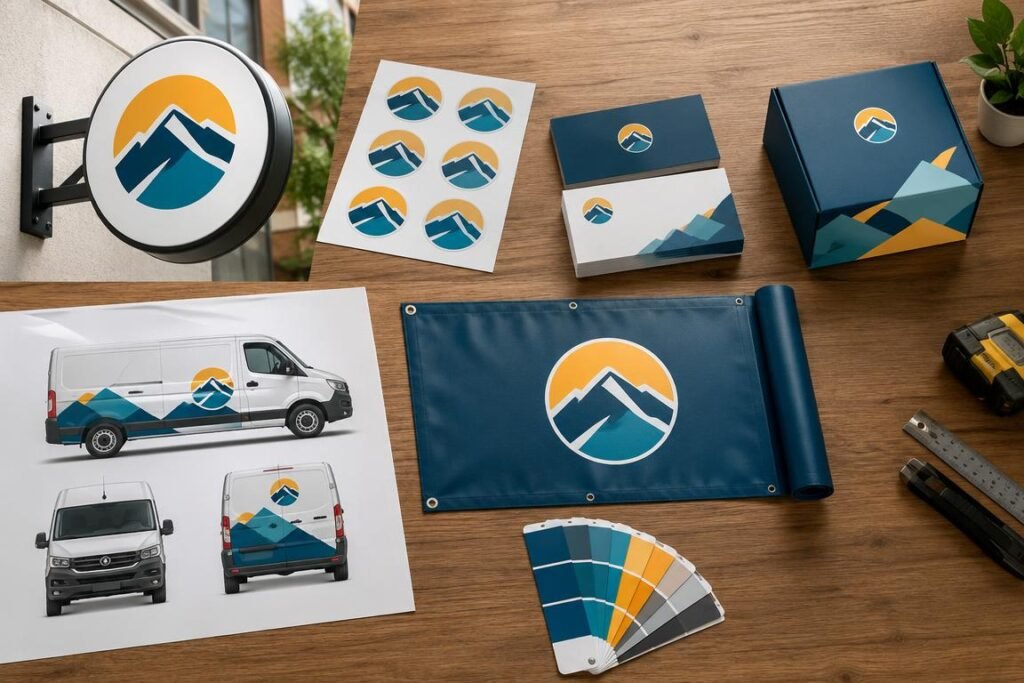
A digital logo is a starting point. A physical brand asset is where people see, touch, or use that identity in daily life. The logo may appear on a website, but it can also work on a storefront, delivery van, uniform, box, wall, or business card.
The same idea applies to brand identity. A color palette and font choice can guide a sign maker, printer, packaging supplier, or fabricator. Your job is to make sure the identity stays clear across different sizes, materials, and viewing distances.
A digital logo becomes more valuable when it works clearly on a real storefront.
Common physical branding assets include:
- Storefront signage and window graphics
- Business cards, brochures, menus, and printed branding
- Vehicle graphics, delivery labels, and outdoor banners
- Product packaging, stickers, inserts, and shipping boxes
- Office branding, wall graphics, reception signs, and room displays
- Event backdrops, table displays, uniforms, and name badges
These items are not random extras. Each one helps the customer look professional, stay memorable, or make the buying experience easier.
Find the next physical brand opportunity
Review your last five design projects. Look for a business that has a new logo but no clear sign, packaging system, or printed customer touchpoint.
How to Identify Clients Who Need Physical Branding Assets
Good design client upselling begins with listening. Do not offer a product simply because it can increase your sale. Look for a visible business need and connect your recommendation to that need.
Ask simple questions at the right time
- Where will customers first see your business?
- How do people find your location or recognize your team?
- Do you sell products in a shop, at events, or through delivery?
- What will change after the new logo or brand identity launches?
- Which customer touchpoint feels old, unclear, or inconsistent?
A new restaurant may need a menu, window sign, takeaway stickers, and delivery packaging. A home service company may need vehicle graphics, uniforms, yard signs, and door hangers. A growing office may need reception lettering and room signs.
Watch for useful signals. The customer may mention a new location, a launch date, a trade show, a new vehicle, or a plan to hire staff. These events create natural opportunities for upselling. They also give you a reason to ask questions without making the conversation feel like a sales script.
Use a recommendation, not a pressure pitch
Try this conversation: “Your logo is ready for digital use. Since customers will visit the new location, would you like me to show you two signage options that keep the brand easy to recognize?”
This wording respects the customer. It asks permission, explains the reason, and offers options. It does not assume that the customer must buy an expensive version product.

A short conversation can uncover a real customer need before you suggest an upsell.
Build Packages That Make the Upsell Easy to Understand
Customers often struggle when every product is presented as a separate decision. Clear packages reduce confusion. They also help you explain the value of combining services.
Foundation package
Best for a new or small business that needs a consistent starting point.
- Logo and brand identity files
- Business card design
- Basic sign or window graphic
- Simple usage guide
Visibility package
Best for a local business that wants to be noticed in more places.
- Signage design and production support
- Vehicle graphic layout
- Outdoor banner or window graphics
- Printed customer materials
Launch package
Best for a company opening a location or launching a new offer.
- Complete logo applications
- Interior and exterior signs
- Packaging or event display
- Production coordination and quality review
Show what changes between tiers. The customer should understand the purpose, not only the quantity. A foundation package creates consistency. A visibility package improves recognition. A launch package coordinates many touchpoints at one important time.
Price design, production, project management, delivery, and installation as separate parts when needed. This protects your margin and gives the customer useful information. A printed product may have material, setup, shipping, and finishing costs that are not part of your creative fee.
Present value before price
Explain what the investment helps the business do. A clear storefront sign can help people find the location. Vehicle graphics can turn daily travel into repeated exposure. Professional packaging can make a small company feel more trusted.
Avoid promising guaranteed sales. Say that the asset supports visibility, consistency, and a better customer experience. This honest approach builds a long-term relationship.
Price, Scope, and Produce Physical Assets With Care
Physical work needs a stronger scope than a typical digital product. Write down the size, material, colors, artwork format, number of revisions, quantity, delivery method, and installation responsibility.
- Final measurements and approved artwork
- Number of items and production quantity
- Design, setup, and project management fees
- Proofing, delivery, and installation details
Include in your scope
- Location and viewing distance
- Material and finish preferences
- Required launch or delivery date
- Who approves the final purchase
Confirm with the customer
- Spelling, phone numbers, and web addresses
- Color and size on the final proof
- Local sign rules or property limits
- Shipping, access, and installation conditions
Check before production
Build relationships with reliable printers, sign makers, fabricators, and installers. Ask about their lead time, proof process, minimum order, materials, quality checks, and replacement policy. Request samples when a finish or color is important.
Do not hide production uncertainty. If a supplier has not confirmed a price, label it as an estimate. If installation depends on a site visit, say so. Clear information protects both you and the customer.
A clear production plan helps a customer understand what they are buying.
Avoid common mistakes
- Do not promise a production date before checking the supplier.
- Do not send artwork without confirming scale and file requirements.
- Do not assume a screen color will match every printed material.
- Do not include unlimited revisions for a complex physical order.
- Do not make the customer responsible for details you failed to explain.
Need a production-ready plan?
Use a short project review to connect your brand identity, physical assets, budget, and launch date before you request a supplier quote.
Follow This Six-Step Upselling Workflow
A repeatable workflow makes upselling cross-selling easier. It also gives the customer a calm path from an idea to a finished product.
- Start with the main design goal. Learn why the customer wants a new logo, website, campaign, or brand identity.
- Map the customer journey. List where people meet the business, such as a street, vehicle, product box, office, event, or email.
- Spot the physical gap. Identify places where the current brand is missing, hard to read, or inconsistent.
- Recommend one useful next step. Explain the problem it solves. Do not present every possible product at once.
- Show a simple visual. Use a mockup or sample so the customer can understand the result quickly.
- Scope and confirm. Set the price, production details, timeline, approval steps, and next action in writing.
For example, a logo customer may say, “We are opening our first studio next month.” You can respond: “A sign and window hours will help new visitors find you. I can create a matching signage option and coordinate a production quote.” That is a helpful upsell because it follows information the customer already shared.
Cross-selling can also happen after the first purchase. A customer who buys a storefront sign may later need staff shirts, an event banner, or branded packaging. Keep notes about future needs, but follow up at a useful time. Do not send repeated messages that feel like pressure.
Simple rule: One customer need, one clear recommendation, one easy next step. This keeps successful upselling focused and respectful.
Use CTAs That Match the Customer’s Readiness
Not every reader is ready to request a quote. Match the CTA to the buyer journey. This is one of the strongest lessons from the ranking pages: education should lead naturally to action.
Early-stage reader
Offer a useful checklist or planning guide. The reader is learning about physical branding assets and may need more information before a purchase.
Interested client
Offer a project review. This person has a logo or brand identity and wants help choosing the right product service.
Ready buyer
Offer a request form. Ask for the business type, asset needed, location, timing, and budget range.
Use benefit-led CTA text. “Plan your storefront signage” is clearer than “Learn more.” “Review your logo applications” tells the customer what will happen next. Keep the tone confident, but make the action optional.
For Growthby10x, add an internal link to logo design services and an external opportunity to a trusted upselling education resource. You can also link to a future signage production guide. Descriptive anchors help people and search engines understand the destination.
Turn Your Next Digital Project Into More Client Value
Upselling real-world assets to design clients is not about adding an expensive version product to every proposal. It is about noticing where a brand must work in the real world. A clear logo may need a readable sign. A new business may need printed branding. A growing company may need vehicle graphics, packaging, or office branding.
Start with listening. Ask questions about the customer, their people, their location, and their next launch. Recommend one product or service that solves a visible problem. Then give the customer clear information about price, quality, production, and timing.
Your best upsell may be the asset that makes the original design useful every day. Look for that opportunity, explain the value, and help your customer take the next step with confidence.